Machine learning for scientific discovery: the solvability frontier
Corpus: solvability atlas, 5,080 problem statements across seven branches, bge-small-en-v1.5 embeddings, 50 stored neighbours per row
Abstract
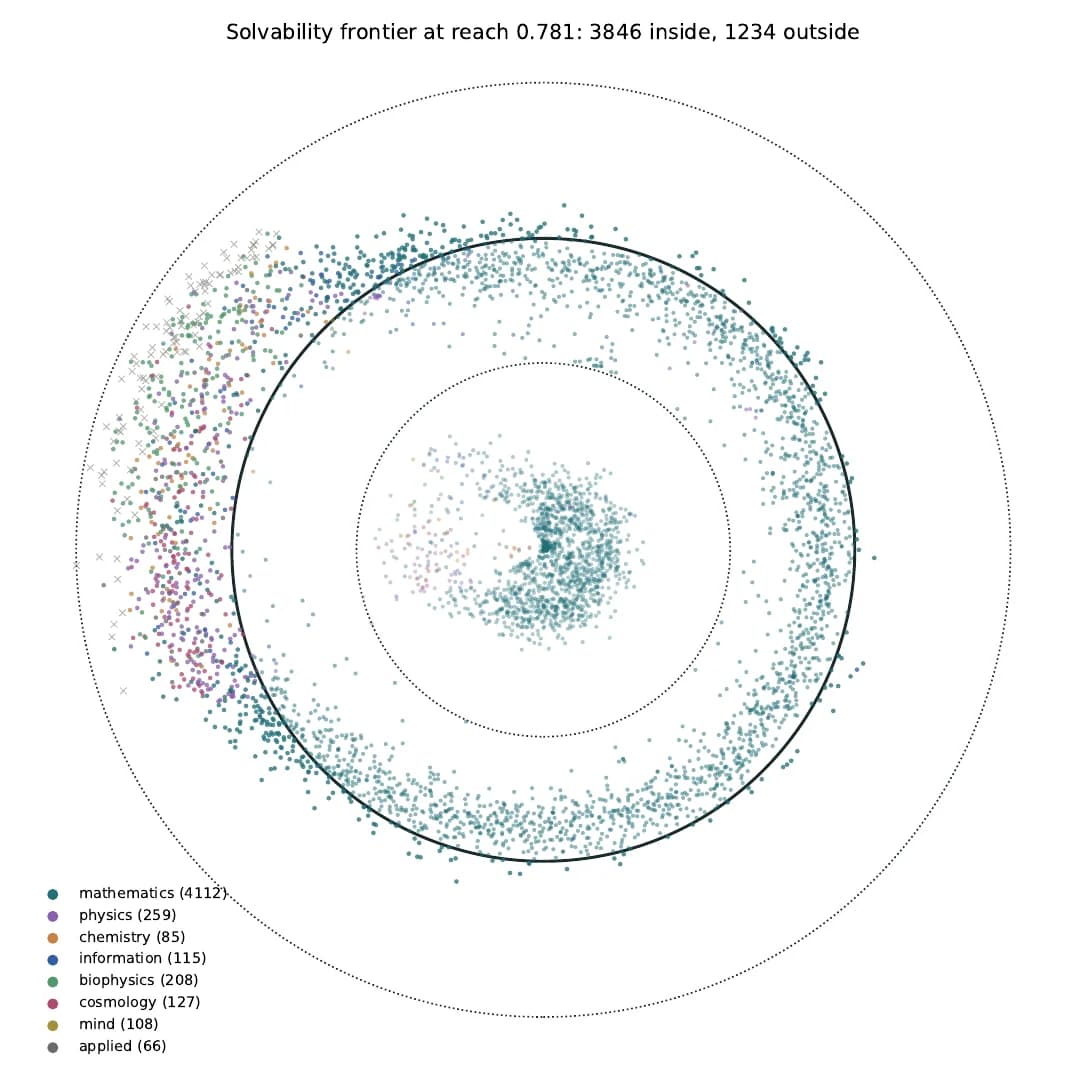
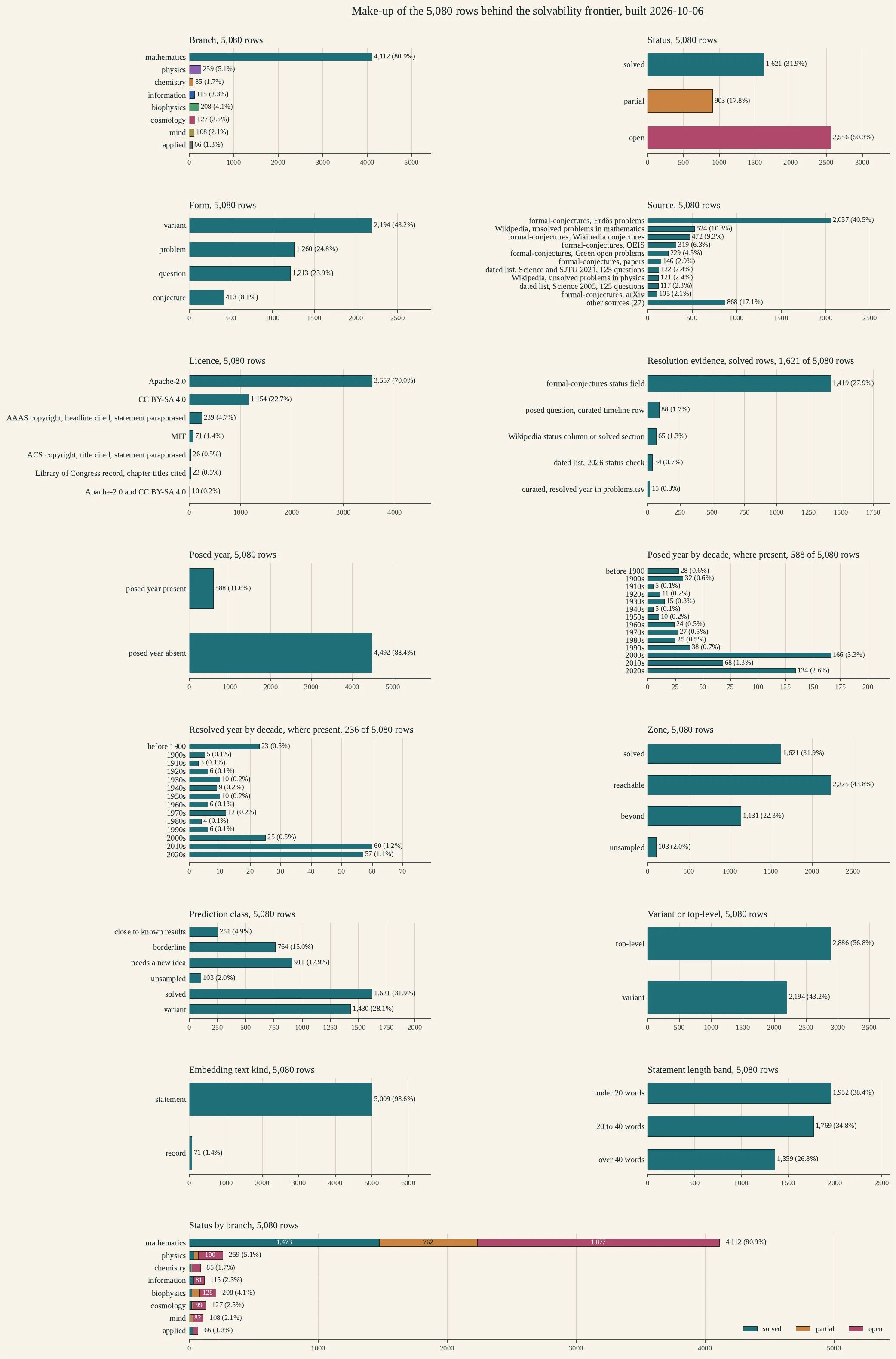
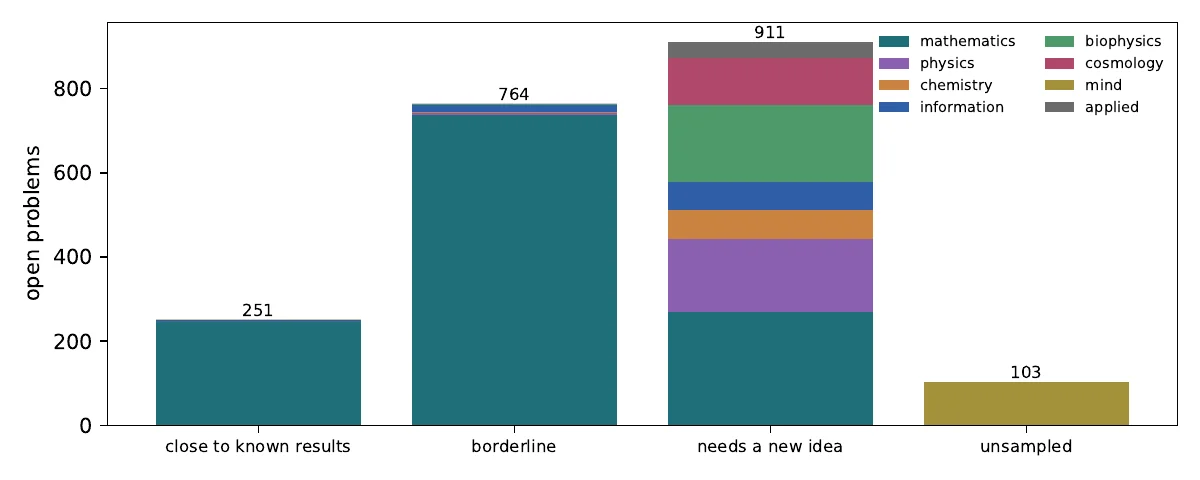
A first pass, the Solver Gap Engine of 2026-09-30, ranked 1,364 open problems from the formal-conjectures repository by their nearest solved problem in another file and found 31 at cosine similarity 0.8 or above. The frontier is the second pass. We embed 5,080 problem statements across seven canon branches with a small sentence encoder, call a problem's reach its highest similarity to a solved problem, and draw a frontier at the 10th percentile of solved problems' reach, 0.781 on this set. Open problems are sorted into a reach class: 251 close to known results, 764 borderline, 911 that need a new idea and 103 in a branch with too few solved rows to judge.
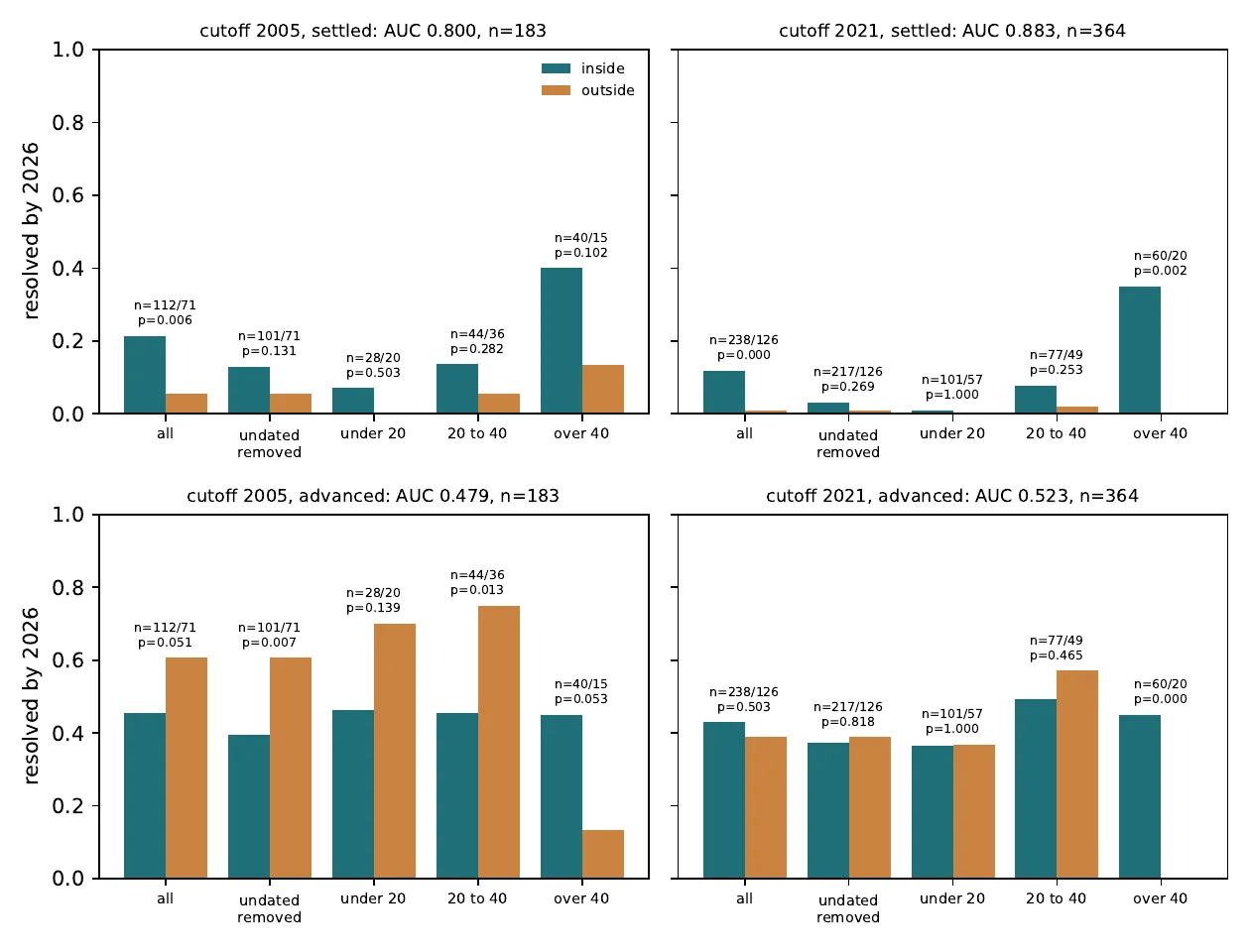
A backtest at cutoffs 2005 and 2021 scores the rule on the questions posed by those years under two outcome codings, and the backtest is inconclusive. Settled only: at 2005 the inside rows settle at 21% against 6% outside (112 and 71 rows, permutation p = 0.006, AUC 0.800) and at 2021 at 12% against 1% (238 and 126 rows, p < 0.001, AUC 0.883), but 11 and 21 of the scored rows are solved rows with no resolved year, and without them the gaps are 13% against 6% (p = 0.131) and 3% against 1% (p = 0.269). Settled or advanced: 46% inside against 61% outside at 2005 (183 rows, p = 0.051, AUC 0.479) and 43% against 39% at 2021 (364 rows, p = 0.503, AUC 0.523). The verdict depends on how partial is coded, and the embeddings and stored neighbours come from the 2026 corpus, so the test is a check against known outcomes under that leak and no forecast.
Key findings
- Solver Gap Engine, 2026-09-30: 3,599 formal-conjectures problems mapped, 1,364 open problems ranked, 31 at cross-file similarity 0.8 or above, median 0.586 against 0.167 for a random pair.
- Frontier at reach 0.781 on 5,080 rows: 1,621 solved, 2,225 reachable, 1,131 beyond, 103 unsampled; 3,644 of the 3,846 inside rows are mathematics.
- The backtest is inconclusive: the settled-only gap (21% against 6% at 2005, 12% against 1% at 2021, p = 0.006 and p < 0.001) is carried by solved rows with no resolved year and drops to p = 0.131 and p = 0.269 without them; the settled-or-advanced AUC sits within 0.03 of chance at both cutoffs.
- Predictions by class for 2,029 open top-level problems, with the three nearest solved problems and starting works per row, published as predictions.csv.
Figures
Data and code
- predictions.csv, 2,029 ranked open problems; CC BY-SA 4.0, carries Wikipedia and formal-conjectures statements, attributed per row ↗
- backtest.json, both cutoffs and codings; CC BY-SA 4.0, carries row statements ↗
- makeup.json, counts per label; CC0 ↗
- frontier.svg, the drawing; MIT code output over CC BY-SA 4.0 and Apache-2.0 data, attributed ↗
- fig_frontier, fig_makeup, fig_backtest, fig_classes (webp); MIT code output over CC BY-SA 4.0 and Apache-2.0 data, attributed ↗
- formal-conjectures, Apache-2.0 ↗
Cite this paper
@techreport{dichio2026solvabilityfrontier,
  title        = {Machine learning for scientific discovery: the solvability frontier},
  author       = {Dichio, Gianangelo},
  institution  = {Bucket Foundation},
  year         = {2026},
  month        = {10},
  url          = {https://www.bucket.foundation/research/papers/solvability-frontier},
  note         = {Full report, version 1.0, 2026-10-07}
}