Public funding and researcher careers: funder portfolios, career-stage composition, and why the funded-vs-unfunded productivity gap is mostly selection, not effect
Corpus: research-atlas v0.5.0, 1,740,326 grant-PI edges; a grant_pi_person bridge resolving 528,570 (30.4%) to 59,180 canonical researchers (concept DOI 10.5281/zenodo.20774322)
Abstract
Papers 01-03 in this series studied the funding graph without ever touching the people side: a grant's principal investigator (PI) was a name-only node with no ORCID, so funding could not be joined to careers at all. A new conservative resolver closes that gap, producing a grant_pi_person bridge that links 528,570 of the 1,740,326 PI edges (30.4%) to 59,180 distinct canonical researchers (490,839 edges carry an ORCID).
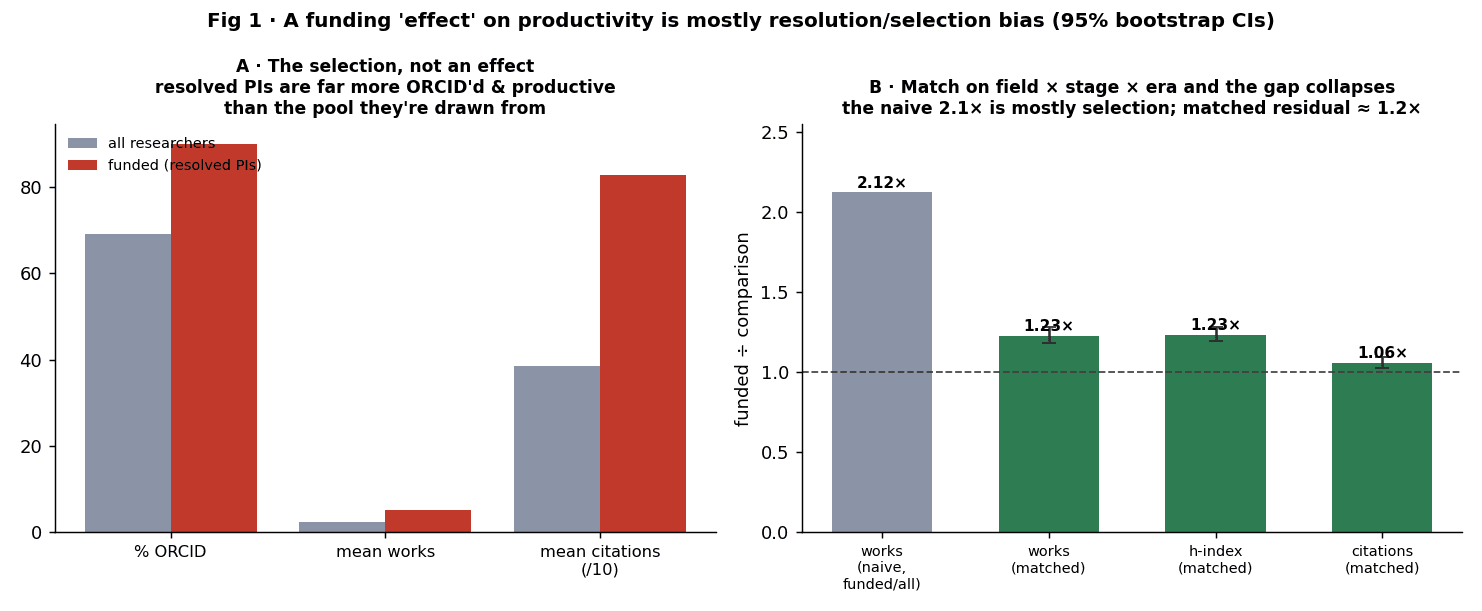
This paper asks how public funding maps onto researcher careers, and its central methodological move is to refuse a tempting false claim. The resolver succeeds precisely on ORCID-era, OpenAlex-indexed, more-productive researchers: the resolved "funded" population is 89.9% ORCID'd vs 69.1% for the canonical researcher pool it is drawn from (a +20.8pp gap), with 2.12× the mean publications. So a naive "funded researchers publish 2× more" is confounded by resolution/selection bias, not a funding effect, and we state that up front and quantify it.
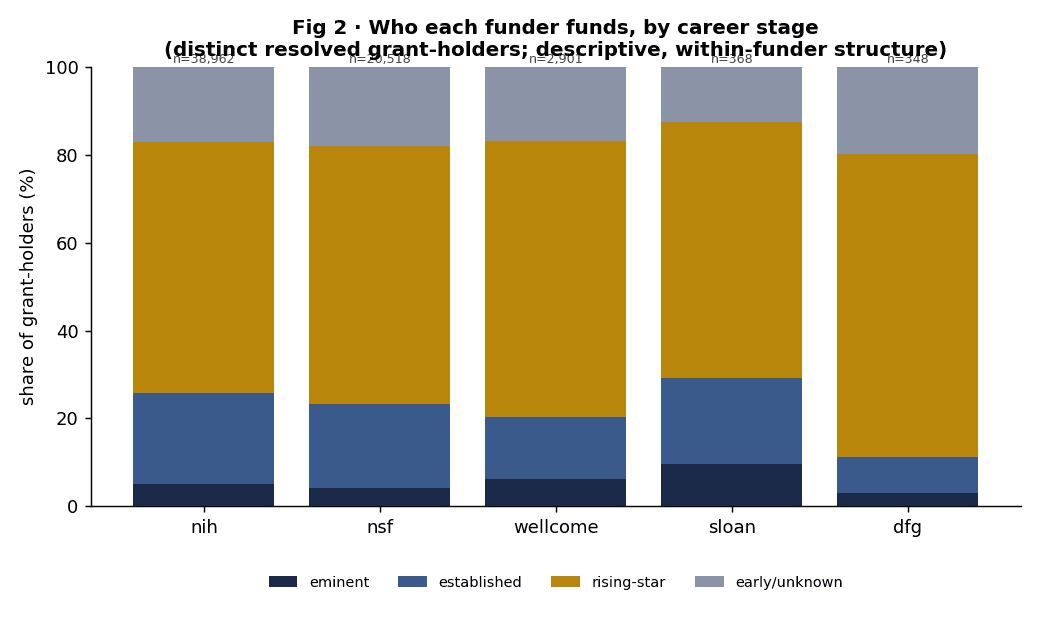
We then make three descriptive claims that survive the bias. (1) Who each funder funds: Sloan funds the most eminence-skewed portfolio (9.5% eminent, median 451.5 citations), DFG and Wellcome the most early-career-skewed (DFG 69.0% rising-stars); NIH's grant-holders are 88.0% biomedical, NSF's span the disciplines with no field above 28%. (2) Career-stage composition: across the funded population, 58.8% are rising-stars, 19.2% established, 4.6% eminent; grant-holding is concentrated (median 4 grants/researcher, max 394). (3) Funded vs comparison, stated plainly: restricting to the resolvable population and matching on field × career-stage × entry-era, the naive 2.11× publication ratio collapses to a matched residual of 1.23× works (95% CI [1.18, 1.28]), 1.23× h-index, and only 1.06× citations, roughly 80% of the apparent gap is selection. We make no causal claim; the selection-bias treatment is itself the contribution.
Key findings
- The headline is a refusal: the naive 2.1× funded-vs-unfunded publication gap is mostly selection, matching on field × career-stage × entry-era collapses it to 1.23× works [1.18, 1.28], 1.23× h-index, and just 1.06× citations.
- The resolution bias is measured, not assumed: funded PIs are 89.9% ORCID'd vs 69.1% for the pool (+20.8pp) with 2.12× the mean publications, the confound, not a finding.
- Within-funder portfolios differ in kind: Sloan is the most eminence-skewed (9.5% eminent), DFG/Wellcome the most rising-star-skewed (DFG 69.0%); NIH grant-holders are 88.0% biomedical, NSF's top field is only 28%.
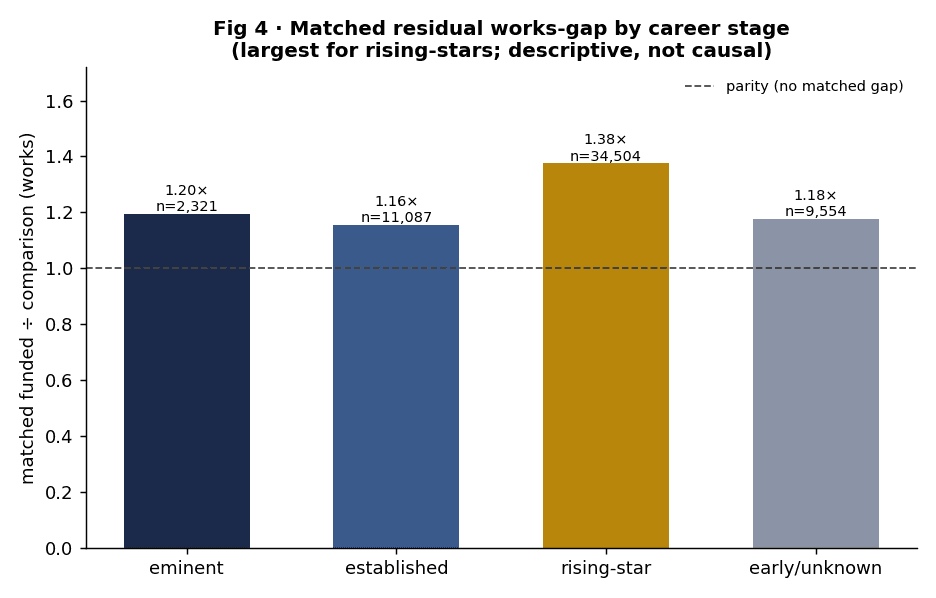
- The matched residual is largest for rising-stars (1.375× works) and smallest for established researchers (1.156×), reported as descriptive structure, explicitly not a causal return to funding.
- No dollar column anywhere; the grant_pi_person bridge carries no PII; every constant is pinned by a seeded test (tests/test_funding_careers.py).
Figures

Cite this paper
@misc{bucket2026fundingcareers,
  title        = {Public funding and researcher careers: funder portfolios,
                  career-stage composition, and why the funded-vs-unfunded
                  productivity gap is mostly selection, not effect},
  author       = {{Bucket Foundation research-atlas working group}},
  year         = {2026},
  howpublished = {Bucket Foundation preprint},
  doi          = {10.5281/zenodo.20836727},
  url          = {https://doi.org/10.5281/zenodo.20836727},
  note         = {research-atlas v0.5.0}
}