07 The Modality Dimension
How knowledge is acquired
The channel, and how far up the depth ladder each channel can carry a learner.
education-atlas field analysis. Figure by [`analysis/landscape/makefiguresmodality.py`](https://github.com/bucket-foundation/education-atlas/blob/master/analysis/landscape/makefiguresmodality.py) (`figmodalityreach.png`). This brief adds the **CHANNEL axis** to the knowledge-access gradient. It is orthogonal to everything in docs `01`, `06`: those docs measure *where* the cliff is (depth, income, geography, time, history) and *who occupies which cell*; this one asks **through what channel** a person climbs the ladder at all, and how far each channel can carry them. It reuses the **L0, L5 depth ladder** and the **consume-vs-produce distinction** built in [`analysis/landscape/scale.py`](https://github.com/bucket-foundation/education-atlas/blob/master/analysis/landscape/scale.py), `02-access-data-science.md`, and the master synthesis `docs/THE-KNOWLEDGE-ACCESS-GRADIENT.md`. Reach headcounts and completion rates below are real cited figures; the depth-ceiling mapping onto the L0, L5 ladder is this project's constructed analytical frame, flagged as such throughout.
0. Why a modality brief
The rest of the corpus answers where and who. It does not answer how, the actual channel a learner uses to acquire knowledge. That channel turns out to be the hidden variable behind the whole gradient, because each modality has a ceiling: a depth on the L0, L5 ladder past which it cannot, in practice, carry a motivated learner. A learner who only ever uses YouTube and Wikipedia does not fail to reach the frontier because they lack ability; they fail because the channel itself tops out two or three rungs below it.
So the modality axis decomposes the depth cliff into five questions, asked of each channel:
- (a) Depth reach, how far up L0, L5 it can realistically carry a motivated
learner.
- (b) Cost, what it costs to use.
- (c) Scale / reach, how many people the channel can serve.
- (d) Credential, whether it confers a recognized credential (the thing that
opens the next institutional gate, per 04-knowledge-gatekeeping-and-what-works.md).
- (e) Production, whether it can reach L5, the place where new knowledge
is added, not just consumed.
The five modalities, ordered roughly from most-scalable to least:
- Formal, school → university → graduate school. Credential-bearing,
institutionally gated, the dominant path to L3, L5 today.
- Informal / open, libraries, MOOCs (Coursera, edX), YouTube and
educational video, podcasts, Wikipedia, open educational resources (OER). Enormous reach, low or zero cost, credential-light.
- Self-directed / autodidactic, books, the open internet, self-study.
Unbounded in principle, rare at the frontier in practice.
- Apprenticeship / mentorship, the master, apprentice relationship, the PhD
advisor. The actual path to L5; transfers tacit knowledge; does not scale.
- AI-mediated, AI tutors and research agents. The emerging modality, and the
wildcard.
The thesis of this brief: the high-reach modalities (informal, open, self-directed) democratize consumption but ceiling out before the gated frontier; the one modality that reaches production (apprenticeship, the lab) does not scale. Every prior modality has been either scalable or capable of reaching production, never both. AI is the first candidate for a modality that is both, a scalable channel (self-directed + AI) that might reach production for the first time. Whether it does is the open question doc 06 left pending, restated here in modality terms.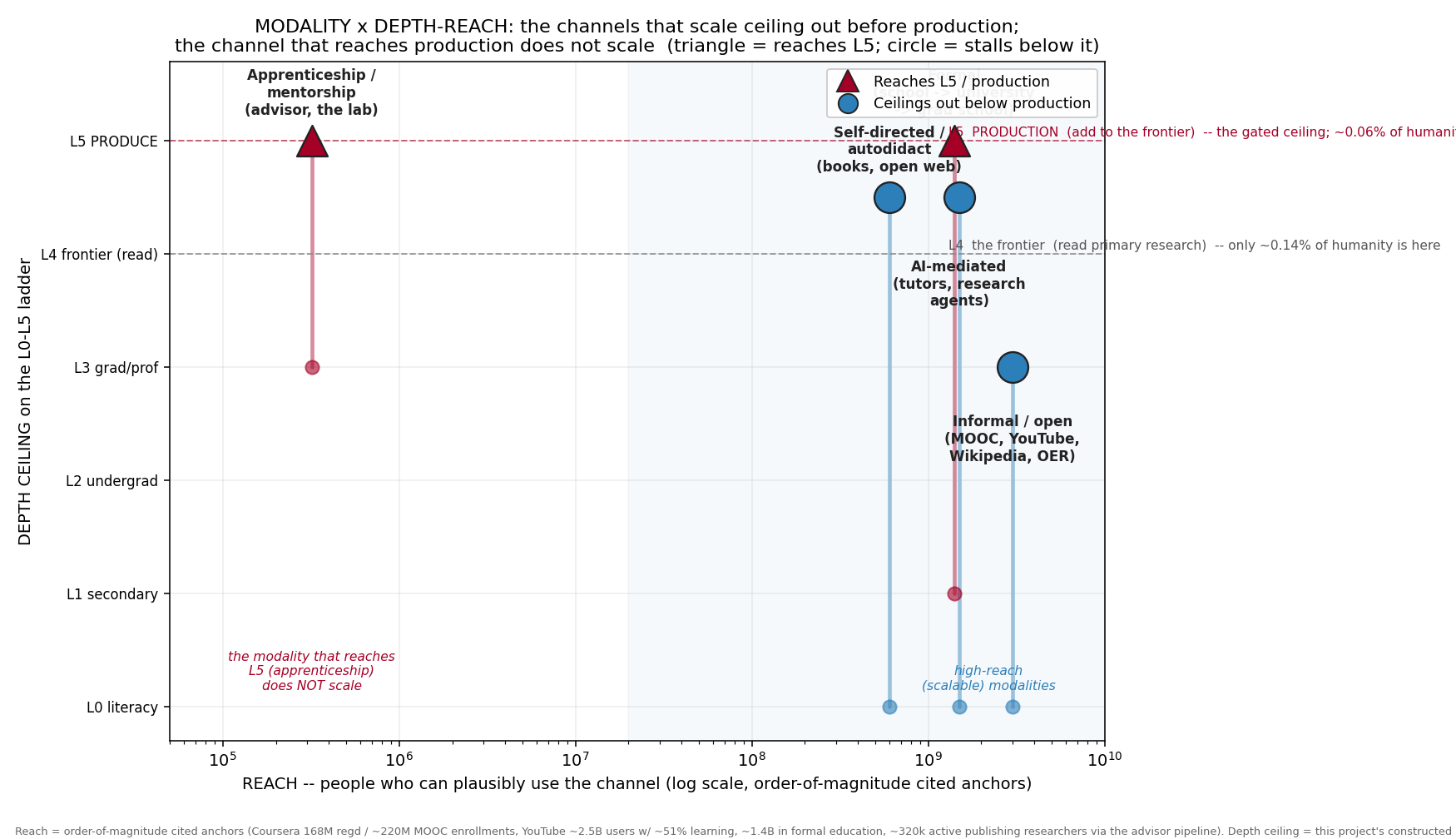
analysis/landscape/figures/fig_modality_reach.png
1. The modality × depth-reach mapping
The core table. Depth ceiling is the realistic ceiling for a motivated Learner using that channel as their primary means. It is neither the floor nor the exceptional case (which §4 treats separately). The L0, L5 mapping is the constructed ladder from scale.py; the reach and cost figures are cited.
| Modality | Depth reach (typical → ceiling) | Cost | Reach / scale | Credential? | Reaches L5 (production)? |
|---|---|---|---|---|---|
| Formal (school→uni→grad) | L1 → L5 | High: ~$12k/yr+ grad; tuition stacks | ~1.4B in formal education worldwide [1] | Yes (the credential is the product) | Yes, the dominant path |
| Informal / open (MOOC, video, Wikipedia, OER) | L0 → L2, L3 ceiling | ~$0 / low | Coursera alone 168M registered learners (2024) [2]; ~220M MOOC enrollments by 2021 [3]; YouTube ~2.5B users, ~51% use it to learn [4] | Mostly no (certificates exist but weak signal) | No, stalls below the gated frontier |
| Self-directed / autodidact (books, open web) | L0 → L4 edge (L5 only exceptionally) | ~$0, low | Anyone literate with internet (~5B+); frontier-reaching autodidacts are vanishingly rare today | No | Rarely, historically yes, now nearly closed |
| Apprenticeship / mentorship (advisor, the lab) | L3 → L5 | Implicit (a funded position) / high per-head | Tiny: bounded by mentor time; ~320k active publishing researchers gate the next generation [5] | Yes (the PhD, the journeyperson card) | Yes, the actual path to production |
| AI-mediated (tutors, research agents) | L0 → L4 edge (L5 contested) | Low/marginal (~$0-20/mo) | Potentially universal (~1.5B+ already reachable) | No (not yet) | Open question, the wildcard |
Two facts jump off this table and define the whole brief:
- The credential column and the L5 column are the same column. Every
modality that confers a credential reaches L5; every modality that does not, does not (the AI row's blanks are exactly why it is the open question). The credential is not a coincidence, it is the mechanism by which a modality opens the next institutional gate (admissions, affiliation, funding) that doc 04 enumerates as 11 structural barriers. A channel that cannot issue a recognized credential cannot, by itself, walk a learner through those gates.
- Reach and production-reach are inversely related. The channels that reach
the most people (informal/open, ~10⁸, 10⁹; self-directed, ~10⁹) top out at L2, L4; the channel that reaches L5 (apprenticeship) serves on the order of 10⁵, 10⁶. Formal education is the one channel that does both, and it does so by being a funnel that sheds people at every rung (doc 03 §3.4: 100 → 9.76 → 0.077 across L0→L3→L5), so its "reaches L5" is true only for the thin survivor stream. The 1.4B headcount does not reach it.
2. The high-reach modalities
Democratized consumption, a hard L2, L3 ceiling.
2.1 Informal / open
The largest expansion of consume-access in history, and its ceiling.
The informal/open modality is the success story of the last twenty years, and the single best illustration of why reach and depth-reach are not the same thing.
The reach is staggering. Coursera reported 168 million registered learners As of end-2024, up 19% year-over-year from 142M in 2023 [2]. Aggregate MOOC enrollments across all platforms passed 220 million by 2021, up from 120M in 2018 [3]. YouTube, the largest informal-learning channel on Earth, has roughly 2.5 billion users, and a 2018 Pew survey found 51% of users use it to learn how to do things they have never done before (87% rate it "important" for that) [4]. Wikipedia, OER, and educational podcasts add hundreds of millions more. This is the modality behind doc 06's and doc 03's finding that consume-access is democratizing fast.
But it ceilings out at L2, L3, and the completion data is how we know. The Defining statistic of the MOOC era is its attrition. A cited comparative analysis finds completion rates ranging from 0.7% to 52.1% with a median of ~12.6% [3]; most courses sit in the 3-15% band [6], and one large analysis found 3.13% of all participants completed in 2017-18, down from ~6% in 2014-15 [7]. Even among certificate-seeking (most-motivated) learners, completion is ~22% versus ~6% for casual browsers [6]; over half of registrants never advance past sign-up, and ~39% never perform any action in the course at all [3].
The reading is not "MOOCs failed", 12% of 220M is still ~26M course completions, a real democratization of breadth. The reading is that the modality is structurally a breadth-not-depth channel: it delivers L0, L2 content at planetary scale to self-selected, intermittent consumers, it issues a weak credential at best, and no informal/open product carries a learner across the L3→L4 comprehension bridge to the gated frontier (the white space doc 01 Identifies and doc THE-KNOWLEDGE-ACCESS-GRADIENT.md §6.2 names as highest impact). The ceiling is not a quality failure; it is the nature of the channel.
2.2 Why the ceiling is structural
Three properties cap the informal/open modality at L2, L3:
- No credential, no next gate. Per doc
04, 11 of the 18 frontier gates are
structural (admissions, affiliation, paywalls/APCs, funded position). A MOOC certificate clears none of them.
- No tacit transfer. The frontier runs on tacit lab knowledge, how to frame a
question, run an instrument, survive peer review, that broadcast video cannot carry (§3).
- Consumption is the affordance. The channel is built to
deliver finished knowledge to many. Originating new knowledge with one sits outside it.
3. Self-directed and apprenticeship: the two opposite failure modes
These two modalities are the poles of the scalability-vs-production tension, so it is clarifying to read them together.
3.1 Self-directed / autodidact
Unbounded in principle, nearly closed in practice.
The autodidactic channel is, on paper, the only high-reach modality with no depth ceiling at all. The open internet plus open access (54% of new papers by 2024, doc 03 §3.3) plus shadow libraries means a literate person with a connection can, in principle, read all the way to L4, the primary literature, for ~$0. And history records that some of the deepest L5 production came from autodidacts: Michael Faraday had almost no formal schooling and little mathematics, taught himself by reading and attending public lectures, and produced foundational electromagnetism [8]; Srinivasa Ramanujan was largely self-taught from a single synopsis of theorems and reached the number-theory frontier with no degree [9]. The autodidact-to-frontier path is real, it built part of the canon.
So why is it nearly extinct now? Because the two things that have not Democratized are exactly the two things the autodidact lacks:
- The frontier's tacit layer. Faraday reached L5 through a mentor, he
became Humphry Davy's assistant at the Royal Institution [8]. Ramanujan reached it through Hardy. The pure autodidact reaches L4 (reading) but the L4→L5 step has, historically, still required a master. The cases that look like "pure self-teaching to production" almost always have an apprenticeship hidden inside them.
- The structural gates got higher. In Faraday's era the frontier had few
formal gates. Today reaching L5 requires clearing the 18-gate stack of doc 04 , affiliation, funding, ethics approval, peer review, APCs up to $12,850, none of which yields to reading alone. Reading the frontier is now free; being admitted to produce at it is gated tighter than ever.
So the self-directed modality has the highest theoretical ceiling (L4 edge, L5-in-principle) and one of the lowest realized ceilings: it carries the motivated to L2, L3, occasionally to L4 reading, and to L5 only in the rare cases that secretly contain a mentor. It is the channel of unbounded possibility and vanishing probability.
3.2 Apprenticeship / mentorship
The only channel that reaches L5, and it does not scale.
Apprenticeship is the mirror image: a low theoretical reach but the only modality that delivers production. The PhD advisor relationship, the master, journeyman trade, the lab postdoc, these transfer the tacit knowledge That broadcast and self-study cannot: how to choose a tractable problem, run the bench, read between a paper's lines, withstand review. This is why the people who produce knowledge (~320k active publishing researchers, doc 02; the Research-atlas counts 320,879 active publishers among 1.44M distinct researchers) Were almost all trained one-to-one by someone already inside.
The evidence that one-to-one mentored instruction is the most effective modality is old and well established: Bloom's "2 sigma problem" found one-to-one mastery tutoring produced learning ~2 standard deviations above conventional class instruction, the tutored median above the 98th percentile of the class [10]. (Later systematic reviews put the durable, scalable figure closer to ~0.5σ for mastery learning alone and ~0.25-0.37σ for tutoring at scale [10], doc 04 §6.1, the 2σ was inflated by ideal conditions. But even the deflated number is the largest reliable lever known.)
And it does not scale. That is Bloom's entire point: tutoring works, but its Cost is its headcount ceiling. The supply of L5-capable mentors is bounded by the existing L5 population, each of whom can apprentice only a handful at a time. The formal apprenticeship data shows the same scarcity even at the trade level: U.S. Registered Apprenticeship completion rates run below ~35% [11], so even the institutionalized version of the channel sheds most entrants, though those who complete do well (~91% retain employment; ~$49.8k starting journeyperson wage [11]). The channel that reaches production is, structurally, the channel that cannot reach scale.
This is the load-bearing tension of the whole brief: the modality that Scales (informal/open) cannot reach production; the modality that reaches production (apprenticeship) cannot scale. Every modality in human history has been on one side of this line or the other. Formal education is the partial exception only because it bolts a scalable front end (mass schooling, L1, L2) onto an apprenticeship back end (the PhD, L3, L5), and pays for it by shedding 99.9% of entrants before the back end (doc 03 §3.4).
4. AI-mediated: the wildcard
This is the modality doc 06 flagged as the first technology for which the consume-vs-produce verdict is not yet written, restated here as a structural question: can AI be the first channel that is both scalable AND reaches production?
The case that it might break the tension rests on what AI does to the two things that capped self-directed learning (§3.1): it is a candidate scalable substitute for the tacit-transfer and comprehension functions that previously required a mentor.
- As a scalable tutor (the L3→L4 bridge). The strongest early evidence is
promising and narrow. A 2025 Harvard physics RCT (Kestin et al.) found students using a engineered, pedagogically principled AI tutor learned more than double the active-learning control, with reported effect sizes of ~0.73-1.3σ, but over only two weeks, with 194 Harvard undergraduates, on middle-order cognitive skills, with no long-term retention data, and explicitly not a generic chatbot [12]. The Stanford Tutor CoPilot RCT (>700 tutors, ~1,000 students) found a more modest +4 percentage points topic mastery, larger (+9 pp) for students of weaker tutors, a human-AI system rather than AI alone [13]. Read against the discipline of doc 04 (~0.3σ is "substantial"; the Nigeria LLM-tutor RCT was 0.31σ), the verdict is: real, repeatable gains at the L1, L3 consumption range, evidence thinning fast above that, and the strongest results coming from engineered or human-paired systems. Raw consumer chatbots trail them. AI is, so far, a powerful consumption amplifier, which would make it just the next informal/open channel, with a higher ceiling but the same kind of ceiling.
- As a research agent (the L5 question). The new possibility is the
research-agent: tools (Elicit, FutureHouse/Edison, autonomous science agents since 2024, doc 03 §3.3) that perform parts of production, systematic review, hypothesis generation, even autonomous experimental loops. If a self-directed learner plus a research agent can clear the epistemic parts of L5 (framing, method, validation) without a human mentor, then for the first time a scalable modality touches production. That is the upside the doc 06 figure encodes as AI's contested "produce" bar.
The two-sided verdict (and it must stay two-sided, doc foundations/04 rates AI-in-education equity-ambivalent, the evidence too thin to license confident prediction):
- Downside case, AI is just informal/open with a better ceiling. It amplifies
consumption, raises the autodidact's realized ceiling from L2, L3 toward L4, and changes nothing about the 11 structural gates (affiliation, funding, peer review, APCs) that wall off L5. The cognitive-offloading literature even warns it could lower depth-reach by letting learners outsource the desirable difficulties that produce durable learning. On this reading AI moves the blue circle up a little and the line still stops below the red.
- Upside case, AI is the first scalable production modality. It substitutes
for the tacit-transfer function that only apprenticeship provided, lets a self-directed learner reach the L3→L4 comprehension bridge unaided, and, via research agents, performs enough of L5's epistemic work that production stops requiring a human mentor and a funded position. On this reading the line crosses L5 for a high-reach channel for the first time in history.
The structural fact that makes this worth arguing: AI is the only modality that attacks both of the autodidact's two missing pieces at once, the comprehension bridge (as tutor) and the tacit production layer (as research agent). Whether it clears the non-epistemic gates (affiliation, funding, peer-review acceptance, APCs) is a question about institutions and economics. The model does not settle it, which is exactly why doc THE-KNOWLEDGE-ACCESS-GRADIENT.md §6.2 pairs the AI bridge with an author-routed production-economics lever. The model can carry a learner to the edge of production; only changing the gates lets them through it.
5. Synthesis: modality is how the consume-vs-produce gap is built
Reassembled, the modality axis explains mechanically the central finding of the whole corpus, that ~99.86% of humanity only consumes knowledge and ~0.14% reaches where it is produced (doc 02 §2.3):
| Scalable (reaches 10⁸, 10⁹) | Does not scale (10⁵, 10⁶) | |
|---|---|---|
| Reaches production (L5) | empty, the historic impossibility | Apprenticeship / the lab |
| Ceilings below production | Informal/open, self-directed, (AI today) | Formal's failed-funnel majority |
The top-left cell, a modality that is both scalable and production-reaching, has been empty for all of recorded history. That empty cell is the consume-vs-produce gap. The reason 99.86% only consume is that the only channels that reach most people stop at consumption, and the only channel that reaches production cannot reach most people.
AI is the first serious candidate to fill the empty cell. It is the only Modality that is natively scalable (marginal cost ~$0, reach ~10⁹) and attacks the specific functions, comprehension-bridging and tacit production-transfer, that previously confined production to the non-scalable apprenticeship channel. If it fills that cell, it does not widen consumption (every prior technology did that); it changes which kind of access is scarce. If it does not, it joins the long line of consumption amplifiers, books, radio, MOOCs, YouTube, that democratized breadth and left the gated frontier exactly where it was.
That is the modality restatement of doc 06's pending verdict, and it sharpens the reform implication of THE-KNOWLEDGE-ACCESS-GRADIENT.md §6: the highest-impact move is not to build another high-reach consumption channel (that cell is full), but to build the scalable-production channel that has never existed, a self-directed + AI modality deliberately engineered as the L3→L4 comprehension bridge and the L4→L5 production assistant, paired with an economics that opens the non-epistemic gates. The modality data says the prize is not more consumption reach; it is the first channel that scales all the way to production.
6. Limitations
- The depth-ceiling mapping is constructed. Where each modality "tops out" on
the L0, L5 ladder is this project's interpretive judgment (the L0, L5 ladder itself is the constructed frame of scale.py) and stands apart from any measured quantity. The reach headcounts and completion rates are real and cited; the ceiling placements encode the cited evidence but are not themselves a measurement.
- Reach figures are order-of-magnitude and not comparable units. "168M Coursera
registrations," "~2.5B YouTube users of whom ~51% learn," "~1.4B in formal education," and "~320k active researchers" measure different things (cumulative registrations vs active users vs enrolled stock vs producing headcount). The figure uses them as orders of magnitude for scale. They do not support a like-for-like ranking.
- The AI evidence is early (the corpus-wide caveat). The Kestin RCT
is two weeks, single-institution, middle-order skills, engineered tutor; Tutor CoPilot is human-AI not AI-alone; deskilling studies are correlational or small-n. This brief rates AI conditional and contested, exactly as docs 04, 06, and foundations/04 do.
- Anglophone / STEM lean. MOOC, apprenticeship, and AI-tutor evidence is
heavily US/OECD and STEM-weighted; the autodidact cases are Western-canon. The shape of the modality tension generalizes; the specific numbers carry the corpus's standing geographic and disciplinary lean.
- Modalities blend in reality. Real learners braid channels (a formal student
who self-studies on YouTube and uses an AI tutor). The table treats each as a primary channel for analytic clarity; the §3.1 point that "pure" autodidacts contain a hidden apprenticeship is the clearest case of why the pure categories are idealizations.
Sources
- [1] UNESCO Institute for Statistics / global enrollment stock, ~1.4B
learners in formal education worldwide (primary through tertiary, order of magnitude). Consistent with the access proxies in `analysis/landscape/results.json`.
- [2] Coursera Q4/FY2024 financial results, 168M registered learners, +19%
YoY. https://investor.coursera.com/news/news-details/2025/Coursera-Reports-Fourth-Quarter-and-Full-Year-2024-Financial-Results/default.aspx
- [3] Open Praxis, "Uncovering MOOC Completion: A Comparative Study of
Completion Rates from Different Perspectives" (2024), median ~12.6% completion (range 0.7-52.1%); ~220M MOOC enrollments by 2021; >50% never pass sign-up; ~39% never act. https://openpraxis.org/articles/10.55982/openpraxis.16.3.606
- [4] Pew Research Center, "Many Turn to YouTube for Children's Content, News,
How-To Lessons" (2018), 51% of users use YouTube to learn how to do new things; 87% rate it important. https://www.pewresearch.org/internet/2018/11/07/many-turn-to-youtube-for-childrens-content-news-how-to-lessons/
- [5] OpenAlex / research-atlas headcount, 1,438,636 distinct researchers;
320,879 active publishers (the L5 mentor pool), via doc 02 §2.3.
- [6] University of Michigan / Teachers College, Columbia summaries, certificate
seekers ~22% vs casual ~6% completion; most MOOCs 3-15%. https://record.umich.edu/articles/research-shows-certificates-boost-mooc-completion-rates/
- [7] Inside Higher Ed / MIT-Harvard edX analysis, 3.13% of all participants
completed in 2017-18, down from ~6% in 2014-15. https://www.insidehighered.com/digital-learning/article/2019/01/16/study-offers-data-show-moocs-didnt-achieve-their-goals
- [8] Michael Faraday, largely self-taught, little formal math, reached the
frontier via assistantship to Humphry Davy at the Royal Institution. (List of autodidacts, Wikipedia; standard biography.)
- [9] Srinivasa Ramanujan, self-taught from G.S. Carr's synopsis, reached the
number-theory frontier without a degree. https://www.britannica.com/biography/Srinivasa-Ramanujan
- [10] Benjamin Bloom, "The 2 Sigma Problem" (Educational Researcher, 1984);
Nintil systematic review, one-to-one mastery tutoring ~2σ in ideal conditions, ~0.5σ (mastery) / ~0.25-0.37σ (tutoring at scale) durable. https://journals.sagepub.com/doi/10.3102/0013189X013006004 · https://nintil.com/bloom-sigma/
- [11] U.S. Department of Labor / Apprenticeship.gov & Center for American
Progress, Registered Apprenticeship completion <~35%; ~91% retain employment; ~$49.8k journeyperson wage. https://www.americanprogress.org/article/wage-gaps-outcomes-apprenticeship-programs/ · https://www.apprenticeship.gov/data-and-statistics
- [12] Kestin et al., Harvard physics AI-tutor RCT (Scientific Reports, June
2025), ~0.73-1.3σ vs active learning; 194 students, 2 weeks, middle-order skills, engineered tutor. Review: https://etcjournal.com/2025/11/10/review-of-kestin-et-al-s-june-2025-harvard-study-on-ai-tutoring/
- [13] Stanford NSSA, "Tutor CoPilot: A Human-AI Approach for Scaling Real-Time
Expertise", +4 pp topic mastery (+9 pp for weaker tutors), >700 tutors / ~1,000 students. https://nssa.stanford.edu/studies/tutor-copilot-human-ai-approach-scaling-real-time-expertise
Cross-references: `docs/THE-KNOWLEDGE-ACCESS-GRADIENT.md` (master synthesis, consume-vs-produce thesis §2.3, white space §6.2); `02-access-data-science.md` (the L0, L5 cliff, ~0.14% frontier); `03-map-expansion.md` (§3.4 the funnel, §3.3 democratizing reading not production); `04-knowledge-gatekeeping-and-what-works.md` (the 18 gates, what-works effect sizes); `06-historical-access-arc.md` (the consume-vs-produce arc and AI as the first open question); [`analysis/landscape/scale.py`](https://github.com/bucket-foundation/education-atlas/blob/master/analysis/landscape/scale.py) (the constructed L0, L5 ladder).