06: The Historical Access Arc
The long arc of knowledge access
Era by era, and the one pattern that has never broken.
education-atlas landscape analysis. Generated by [`analysis/landscape/buildhistorical.py](https://github.com/bucket-foundation/education-atlas/blob/master/analysis/landscape/build_historical.py) → resultshistorical.json`; figures by `makefigureshistorical.py` (`figliteracylongrun.png`, `figaccessarc.png`). The **time axis** of the knowledge-access gradient, pushed back across all of recorded history, the long-run complement to `03-map-expansion.md`, whose temporal section ran only 2000→2024. It reuses the **L0, L5 depth ladder** and the **consume-vs-produce distinction** built in `02-access-data-science.md` and the master synthesis `docs/THE-KNOWLEDGE-ACCESS-GRADIENT.md`. The long-run series are real cited anchors; every era *verdict* is interpretive and flagged as such below.
0. Why a historical brief
Docs 02, 05 photograph the knowledge-access gradient as it stands today: a cliff down the depth axis, bought by income, gated by institutions, and an emptiest-market top corner where ~0.14% of humanity reaches the frontier. Doc 03 showed that along one short slice of time, 2000 to 2024, the read-access cliff is eroding fast (open access 12%→54%, internet 6.7%→68%). This brief asks the longer question the rest of the corpus brackets: across all of recorded history, how has access to knowledge moved, and for whom?
The reason to ask it historically is that the corpus's single most load-bearing claim, that reaching the frontier and producing there are different problems, and only the first is democratizing, is argued from a 24-year window. If the claim is real, it should hold from 2000 to 2024 and from the first clay tablet to the latest language model. It does. The whole arc of knowledge technology, read end to end, tells one story with one exception pending:
*Every prior technology widened access to consume knowledge, to read, learn, and reach what others had already discovered. None widened access to produce it, to originate, validate, and add to the frontier. Reading the frontier is now nearly free; producing it remains gated. AI in the 2020s is the first technology for which that verdict is not yet written.*
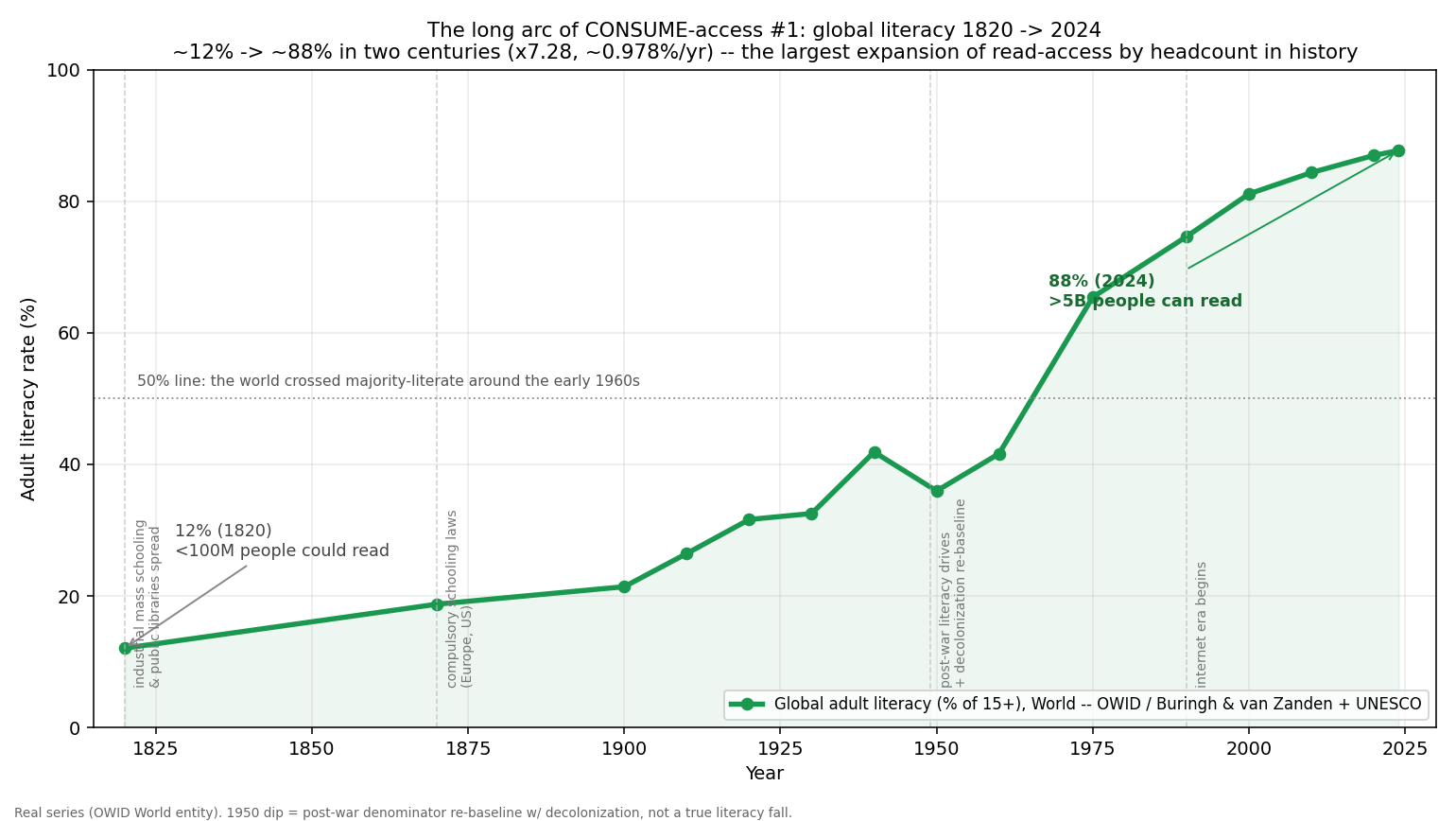
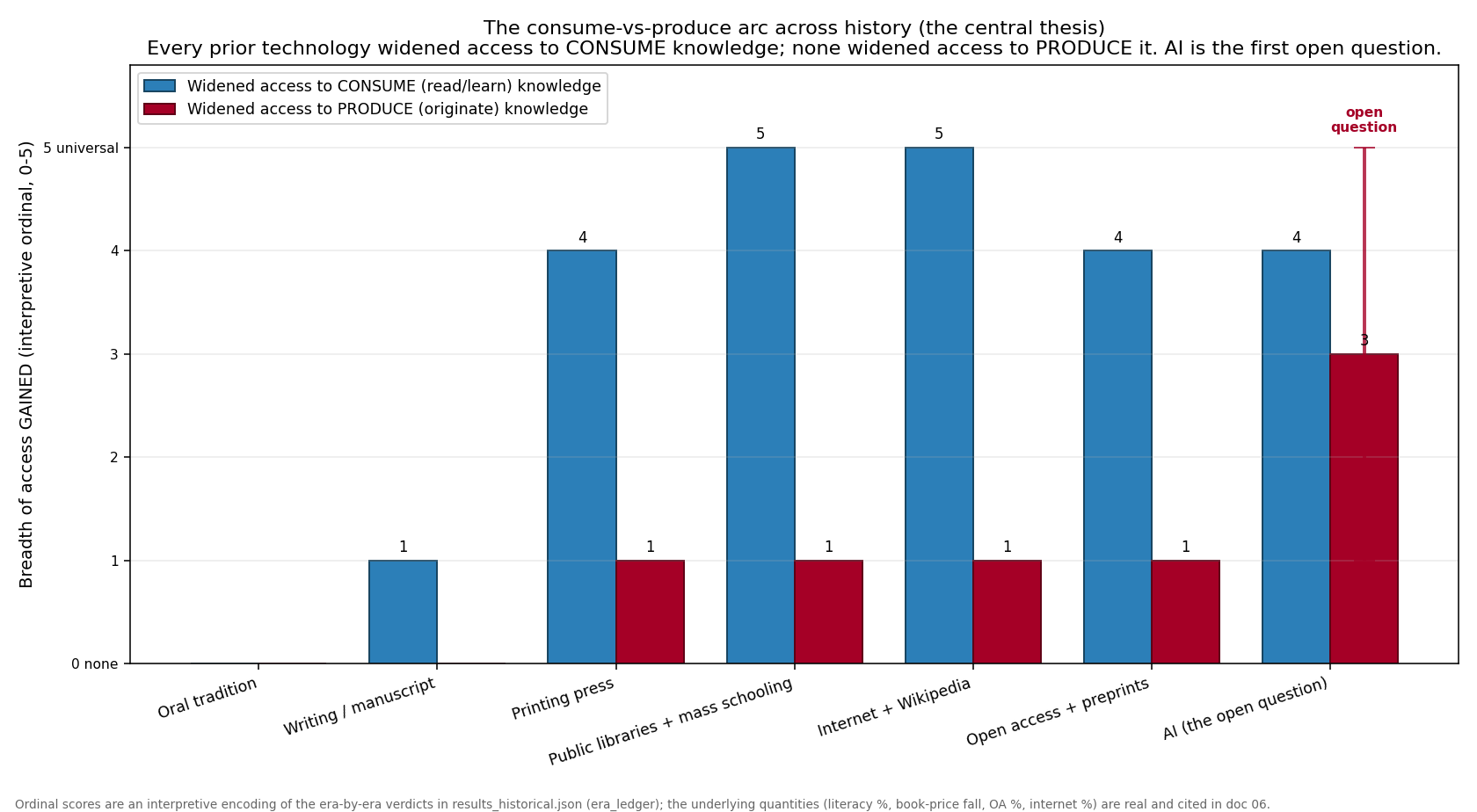
This is the same consume-vs-produce gap doc 02 measures as a cross-section, extended into a thesis about technological history. The two figures below plot it: the long-run literacy curve (the headline case of consume-access widening) and the era-by-era arc (the same thesis as an ordinal ledger).
analysis/landscape/figures/fig_literacy_longrun.png
1. Oral tradition
Knowledge bounded by memory and mortality.
For the overwhelming majority of human existence there was no external store of knowledge at all. What a people knew, they held in living memory, in elders, bards, ritual, song, and the trained recall of specialists. The Homeric epics, the Vedas, the genealogies of pre-literate societies: all were transmitted by mouth and ear, sometimes with astonishing fidelity, but always at the mercy of the next generation's willingness and ability to memorize and retell.
On the consume/produce axis this era is the degenerate base case, because there is no external medium to consume from and nothing that persists to add to. Access was, in one narrow sense, universal, everyone in the group could in principle hear and learn the tradition, but it was also strictly bounded: you could only know what living memory could hold, and nothing survived a generation it was not retold to. Anyone could contribute a story or a refinement, but the contribution decayed; there was no cumulative frontier to stand on, only the ceaseless re-transmission of a fixed inheritance. Plato's Phaedrus records socrates worrying that writing itself would weaken memory, a reminder that each new knowledge technology has been received as a threat to the capacity it was about to amplify, a pattern that recurs at every era boundary down to AI.
Verdict: neither consume- nor produce-access scaled. Knowledge was capped By the size and lifespan of human memory. (Interpretive; the framing is the analysis's, the durability-of-oral-tradition facts are uncontroversial in the literature.)
2. Writing and the manuscript era: the first external store / gated to an elite
The invention of writing (~3200 BCE in Mesopotamia) is the first true inflection in this entire arc: for the first time, knowledge could outlive the person who held it and travel beyond the people who heard it. A law, a measurement, a proof could be fixed and recovered. This is the moment external storage begins, and with it, the first version of consume-access: the ability to read what someone else, possibly long dead, had recorded.
But the widening was tiny, because two things gated it hard. The first was literacy itself: through antiquity and the European Middle Ages the share of people who could read was in the low single digits to perhaps ten percent at the high end, concentrated in scribes, clergy, administrators, and aristocracy. The second was the staggering cost of a copy. Every manuscript book was reproduced by hand, one page at a time, a skilled scribe managed only a few pages a day, so a single substantial codex represented months to years of labor, plus the cost of parchment (which consumed whole animal herds for a large book). The result is that a book in the manuscript era could cost the equivalent of a craftsman's annual income or a small house. Knowledge had an external store, but the store was a vault, and almost no one held the key.
Production was, if anything, more tightly held than consumption. New knowledge was originated and curated inside monasteries, cathedral schools, and a handful of courts; making even a copy, let alone an original work, required years of trained labor and institutional sponsorship. The medieval university (Bologna ~1088, Paris and Oxford in the following century) professionalized scholarship but did not democratize it; it built the first version of the credential gate that doc 02 finds still standing at L3, L5 today.
Verdict: the arrival of external storage widened consume-access slightly (knowledge could now persist and travel) but left both reading and producing gated to a literate elite. The frontier existed, but it was a cloister.
3. The printing press: the first great democratization / the canonical case
Gutenberg's movable type, around 1440, is the hinge of the whole arc, and the single cleanest demonstration of the thesis. It is the first technology that collapsed the cost of a copy by orders of magnitude, and the consequences fanned out across literacy, religion, science, and politics within a century.
The cost collapse is well measured. Between 1450 and 1500 the real price of a book fell by roughly two-thirds in the Low Countries, and by ~75% in England between 1450 and 1530, a sustained decline of roughly −2.4% per year in raw price (≈ −1.7%/yr quality-adjusted) for about a century (Dittmar, 2011, QJE; van Zanden). This is the largest one-shot collapse in the cost of a unit of recorded knowledge before the internet. On the supply side, the throughput step change was of the same order: a hand-copyist produced on the order of a few pages a day, an early press on the order of a couple hundred, an ~80-100× jump in copies per unit of labor. Output followed: Western Europe produced on the order of a few hundred thousand to ~2.7 million manuscript books across the entire fourteenth century, then roughly 12.6 million printed books by 1500 (the incunabula era), and on the order of 10⁸ books in the sixteenth century alone (Buringh & van Zanden, 2009, Journal of Economic History 69(2):409-445). Across the manuscript-to-print transition, the books-per-century count rose by something like four orders of magnitude.
The knock-ons are the reason this era is canonical. Cheap books in the vernacular drove literacy upward and broke the Latin-clergy monopoly on Reading. Dittmar's instrumented study finds that European cities which adopted a printing press grew about 60% faster than otherwise-similar cities between 1500 and 1600, so the press was a cultural event and a measurable economic one. Print was the diffusion layer of the Reformation (Luther's tracts spread faster than any institution could suppress them) and a precondition for the Scientific Revolution: reproducible figures, shared tables, and the rapid circulation of results made cumulative, checkable science possible in a way the hand-copied manuscript never could.
And yet, this is the whole point, the press barely moved production access. It collapsed the cost of copying and distributing a work, so it amplified who could be read. It did almost nothing for who could originate: an author Still needed literacy, a press or a printer's contract, and a patron or capital. The printing press is the textbook instance of the thesis: a giant jump in consume-access, a negligible jump in produce-access.
Verdict: the first great democratization of reading; the produce gate left Intact. (Cost-collapse and output figures are real economic-history anchors; the consume-vs-produce reading is the analysis's interpretation.)
4. Public libraries and mass schooling
Consume-access goes from elite to majority.
If the press democratized the book, the nineteenth century democratized the reader. Two public institutions did it: tax-funded public libraries (the UK's Public Libraries Act of 1850; the Boston Public Library, 1854; later the Carnegie library wave) and, far larger in effect, compulsory state schooling, the Prussian model that spread across Europe and was imported to the United States by Horace Mann after 1843 (the same industrial model whose sorting logic doc 04 And THE-KNOWLEDGE-ACCESS-GRADIENT.md §4 critique). Together they took reading from a paid privilege to a public entitlement.
The headline number is the literacy curve in the figure above. Global adult literacy ran about 12% in 1820, fewer than 100 million people on Earth could read and write, and stands at about 88% in 2024, when more than 5 billion people can (Our World in Data, cross-country-literacy-rates, built on Buringh & van Zanden's historical estimates spliced to UNESCO modern data). That is a ~7.3× rise in the rate over two centuries, a compound growth of roughly ~1%/yr, and, because population grew enormously over the same span, by Sheer headcount the single largest expansion of consume-access in human history. The world crossed the 50% majority-literate line around the early 1960s. (The visible dip around 1950 in the series is a denominator effect: Post-war decolonization re-baselined the world population that the rate is computed over rather than a true fall in the number of literate people, flagged in the source and in build_historical.py.)
On the produce side, the nineteenth and twentieth centuries did something two-edged. By making nearly everyone literate they expanded the pool from which producers of knowledge could be drawn, a precondition without which the modern research enterprise is impossible. But at the same time the modern research university and the professionalized PhD enclosed knowledge production behind a credential. Producing validated knowledge became a licensed occupation, with admission, training, affiliation, and funding gates, the L3→L4→L5 stack doc 03 counts as 18 gates, 11 of them structural. So the era that brought reading to the majority simultaneously made producing a credentialed profession. The pool widened; the gate hardened.
Verdict: near-universal consume-access at the base (the literacy floor), and A professionalized, credentialed enclosure of production. The arc's biggest consume-access win and a structural produce-access narrowing, in the same century.
5. The internet and Wikipedia, information abundance
The internet drove the marginal cost of a copy, the thing the press attacked once and libraries attacked again, to zero. Once a text is online, it can be read by one more person for no additional cost, anywhere, instantly. Global internet penetration went from 0% in 1990 to about 68% in 2024 (~5.5 billion people online; World Bank / ITU IT.NET.USER.ZS), a roughly 10× rise in the share online just since 2000 (6.7%→68%). Wikipedia, launched 2001, grew from zero to about 7 million English-language articles and made a free, instantly searchable encyclopedia, the bulk of recorded reference Knowledge, available to anyone with a connection.
This is consume-access at abundance: cheaper books and free, instant, searchable everything-that-isn't-paywalled. It is the second-largest consume inflection in the arc after mass literacy, and the fastest.
But it remained, overwhelmingly, a reading revolution. Yes, anyone could now publish a webpage, and the web lowered the bar to broadcasting an Opinion or a tutorial. But originating validated knowledge, research that survives scrutiny and adds to the frontier, stayed behind exactly the same lab/credential/funding/peer-review gates it sat behind before the internet existed. The internet let you read almost anything; it did not let you do science. The produce-access rate at the frontier (doc 02's ~0.14% of humanity) is unmoved by internet penetration.
Verdict: an abundance of consume-access; produce-access at the frontier Unchanged. The pattern holds.
6. Open access and preprints
Consume-access reaches the frontier for the first time.
The open-access movement is the most important entry in this arc for one specific reason: it is the first technology to extend consume-access all the way to L4, reading the research frontier itself. Every earlier widening reached books, then reference works, then the open web; none of them, on their own, put primary, peer-reviewed and preprint research in front of a person without an institutional subscription. Open access did.
The numbers are in doc 03 and carried here on the same timeline: the open-access share of new papers quadrupled from 12% (2000) to 54% (2024), crossing the 50% line in the early 2020s (OpenAlex / Unpaywall / Curtin COKI bibliometrics). A stack of free infrastructure arrived alongside it, arXiv (1991), Google Scholar (2004), the NIH PubMed Central mandate (2008), bioRxiv (2013), Unpaywall and Semantic Scholar (2015), and OpenAlex (2022). For the first time in history, a motivated person with no university affiliation can read the edge of human knowledge for $0.
And, predictably, given everything above, it did not move production. The moment open access threatened the subscription rent, the gate relocated to the author side as article-processing charges: Nature's open-access APC reached the order of $12,850 per article (the figure the corpus pins from STAT's 2026 reporting; Springer Nature's own current list price for Nature is €10,850, with Nature Methods at $12,690, same order of magnitude, all flagged as Fast-moving). So open access excludes poor authors where subscriptions excluded poor readers, and the prestige, affiliation, and funding gates are entirely untouched. This is the cleanest modern restatement of the thesis: a technology that pushed consume-access all the way up to the frontier while leaving produce-access pinned at its historical rate.
Verdict: consume-access finally reached L4 (reading the frontier); Produce-access (L5) held at ~0.14% of humanity. (OA and internet series are real anchors; the APC figure is a real but fast-moving list price, cited with its range.)
7. AI
The first time the verdict is not yet written.
Every era above resolves cleanly into the same verdict: consume-access widened, produce-access did not. AI is the first entry where an analyst cannot yet sign off on that line, and the corpus's job is to lay out both readings without picking the winner the evidence does not yet support.
analysis/landscape/figures/fig_access_arc.png
The case that AI is just another reading-amplifier. On this view, large Language models are the most powerful consume-access tool ever built, and nothing more. They lower the comprehension barrier that open access left standing: AI can explain a paper, not just deliver it, which is a real and new contribution to the L3→L4 bridge that doc 02 finds unbuilt. But explaining the frontier is still reading it. The institutional machinery that gates production, funding (NIH R01 success ~13%), a research position, ethics approval, lab access, peer-review acceptance, the prestige economy, the APC, is entirely outside what a chat box touches. On this reading, AI is to the twenty-first century what the printing press was to the fifteenth: a spectacular amplifier of who can read and understand, and almost no change to who can originate. The early empirical record is consistent with caution, LLM-tutor RCTs are short-term, facilitated, single-context (e.g. Nigeria ~0.31 SD), and the deskilling / cognitive-offloading studies are early and contested (doc 02, foundations/04). The arc's null result has held for five thousand years; the prior should be that it holds again.
The case that AI is the first break in the pattern. On this view, AI is Categorically different from every prior knowledge technology because it does not move knowledge from store to reader, it can operate on it. Hypothesis generation, literature synthesis at a scale no human can match, autonomous experiment design and execution, code that runs analyses, and agents that carry a problem from question to draft result are all production acts, not reading acts. If even part of that holds, AI would be the first technology in the arc to widen access to producing knowledge, to let a motivated, non-institutional person do research rather than only consume it, which is precisely the L3→L4→L5 white space the master synthesis names as the highest-impact region. The earliest gestures in this direction (research-agent tools like Elicit for systematic review, FutureHouse/Edison for autonomous discovery, the "autonomous science agents" milestone the doc 03 timeline marks at 2024) are exactly the species of tool that could, in principle, push the red bar up.
The position is that both readings are defensible on current evidence, and the corpus refuses to resolve what the data cannot. The deskilling studies are too thin to prove AI is * a consumer; the autonomous-science demonstrations are too early and too narrow to prove it is a producer. What can be said precisely is what would count as a break in the Pattern: faster reading, better explanations, and more papers summarized are consume-access wins the arc has delivered before. The break would be a measurable rise in the rate at which non-institutional people originate validated knowledge that survives scrutiny*. That rate, doc 02's ~0.14%, is the number to watch. If AI moves it, the five-thousand-year pattern breaks for the first time. If it doesn't, AI joins the printing press and the internet as the next great amplifier of reading.
Verdict: the only era in the arc where the consume-vs-produce verdict is open. (Wholly interpretive. The corpus rates AI conditional.)
8. The arc in one table
| Era | Approx. start | What changed | Who gained access | Consume-access | Produce-access |
|---|---|---|---|---|---|
| Oral tradition | pre-~3200 BCE | living memory only | the group, bounded by memory | does not scale | does not scale |
| Writing / manuscript | ~3200 BCE | first external store; hand-copied | a literate elite (<~10%) | slight ↑ (persists & travels) | narrowed to scribes/scholars |
| Printing press | ~1440 | movable type; cost of a copy collapses | the vernacular reading public | large ↑ (price −⅔ in 50 yrs; output ×10⁴/century) | barely moved |
| Public libraries + mass schooling | 19th c. | free libraries; compulsory schooling | the general population | largest by headcount ↑ (literacy 12%→88%) | pool ↑ but credential gate hardened |
| Internet + Wikipedia | 1990s | marginal cost of a copy → $0 | ~5.5B people online (68%) | abundance ↑ (internet 0→68%) | unchanged at the frontier |
| Open access + preprints | 2000s | free path to read primary research | anyone, no affiliation | ↑ reaches L4 (OA 12%→54%) | unchanged (APCs re-gate authors) |
| AI | 2020s | models that operate on the corpus | anyone with a chat box | ↑ (also lowers comprehension barrier) | open question |
The consume-access column is an unbroken staircase up. The produce-access column is flat, gated, narrowed, or unchanged, at every step until the last one, where it becomes a question mark.
9. What's real vs. interpretive
| Component | Status | Anchor / assumption |
|---|---|---|
| Global literacy 1820→2024 (12%→88%) | REAL | Our World in Data cross-country-literacy-rates (Buringh & van Zanden 2009 + UNESCO) |
| Book real-price fall (−⅔ 1450-1500; −75% 1450-1530 England) | REAL | Dittmar 2011 QJE; van Zanden |
| Printing-city growth +60% (1500-1600) | REAL | Dittmar 2011 QJE (instrumented on distance from Mainz) |
| Book output (~2.7M MS 14th c.; ~12.6M by 1500; ~10⁸ 16th c.) | REAL order-of-magnitude | Buringh & van Zanden 2009, JEH 69(2):409-445 |
| Internet 6.7%→68% (2000→2024); OA 12%→54% | REAL anchors | World Bank/ITU IT.NET.USER.ZS; OpenAlex/Unpaywall/COKI (reused from doc 03) |
| Wikipedia ~7M en articles | REAL | Wikipedia statistics |
| Nature APC ~$12,850 | REAL but fast-moving | STAT 2026 (corpus pin); cf. Springer Nature list €10,850 / Nature Methods $12,690 |
| Medieval literacy <~10%; scribe vs press throughput | REAL order-of-magnitude | book-history scholarship; B&vZ |
| Era ledger verdicts (consume vs produce per era) | INTERPRETIVE | the analysis's reading of the cited facts |
Ordinal scores in fig_access_arc.png | INTERPRETIVE encoding | ordinal labels for the era verdicts; the underlying quantities are real |
| AI consume-vs-produce verdict | OPEN | rated conditional (consistent with 02, foundations/04) |
Known limitations. (1) The era boundaries are clean labels over a messy, Overlapping reality, oral tradition persists today, the manuscript era did not end the day Gutenberg printed, and the eras co-exist. (2) The long-run literacy and book series are Europe/West-leaning where the deep history is concerned (the B&vZ corpus is European); the shape of the consume-access staircase generalizes, the early absolute numbers are West-centric. (3) The 1950 literacy dip is a denominator artifact of decolonization rather than a true fall. (4) Every verdict in the ledger is an interpretation of the data; the underlying series are real; the consume-vs-produce reading is the analysis's. (5) The AI row is undecided and is presented as a two-sided open question rather than a prediction.
10. Headline
*For five thousand years, every knowledge technology widened access to consume, to read, learn, and reach what was already known, and none widened access to produce it. Writing gave knowledge an external store but gated it to a literate elite. The printing press collapsed the cost of a copy by orders of magnitude (book prices −⅔ in fifty years, output ×10⁴ per century) and lit the Reformation and the Scientific Revolution, but it amplified who could be read, leaving untouched who could originate. Public libraries and mass schooling took literacy from ~12% (under 100 million people, 1820) to ~88% (over 5 billion, 2024), the largest consume-access expansion in history by headcount, while the modern university enclosed production behind a credential. The internet drove the cost of a copy to zero (0→68% online) and open access finally extended reading all the way to the research frontier (OA 12%→54%), and still the rate at which humanity produces new knowledge held at ~0.14%. Reading the frontier is now nearly free; producing it remains gated behind 18 barriers, 11 of them structural. AI is the first technology in the entire arc that might break the pattern, by letting people do research, not just read it, or might be the most powerful reading-amplifier ever built and nothing more. That verdict is not yet written; the number to watch is whether the produce-access rate moves.*
11. Reproduce
cd analysis/landscape
python3 build_historical.py          # -> results_historical.json
python3 make_figures_historical.py   # -> figures/fig_literacy_longrun.png, fig_access_arc.png
Files: `analysis/landscape/build_historical.py` (analysis + era ledger), make_figures_historical.py (the two figures), results_historical.json (output). Sibling docs: 02-access-data-science.md (the access cliff, consume-vs-produce cross-section), 03-map-expansion.md (the 2000→2024 temporal trend), 05-geographic-access.md (the per-country frontier map), and the master synthesis docs/THE-KNOWLEDGE-ACCESS-GRADIENT.md.
Sources: Our World in Data, "Literacy" and the `cross-country-literacy-rates` Grapher (built on Buringh & van Zanden 2009 + UNESCO; CC-BY). Eltjo Buringh & Jan Luiten van Zanden, "Charting the 'Rise of the West': Manuscripts and Printed Books in Europe, A Long-Term Perspective from the Sixth through Eighteenth Centuries," Journal of Economic History 69(2): 409-445 (2009). Jeremiah Dittmar, "Information Technology and Economic Change: The Impact of the Printing Press," Quarterly Journal of Economics 126(3): 1133-1172 (2011). World Bank / ITU `IT.NET.USER.ZS` (internet penetration); OpenAlex / Unpaywall / Curtin COKI (open access share). UNESCO Institute for Statistics (modern literacy). STAT News (2026) and Springer Nature list prices (Nature-portfolio APCs). Plato, Phaedrus (Socrates on writing and memory). Every long-run series is real and cited; every era verdict is interpretive and flagged as such. Reproduce via [`analysis/landscape/build_historical.py`](https://github.com/bucket-foundation/education-atlas/blob/master/analysis/landscape/build_historical.py) + `make_figures_historical.py`.