05
The Geographic & Demographic Map of Frontier Access.
A per-country world map of who reaches the frontier
Who is shut out entirely.
education-atlas `landscape` analysis. Generated by [`analysis/landscape/buildgeographic.py](https://github.com/bucket-foundation/education-atlas/blob/master/analysis/landscape/build_geographic.py) → resultsgeographic.json`; figures by `makefiguresgeographic.py`; headline numbers pinned by `testgeographic.py. Extends 02-access-data-science.md and 03-map-expansion.md on the **same L0, L5 depth ladder** from scale.py. Real anchors are World Bank (SP.POP.SCIE.RD.P6, SE.TER.ENRR, IT.NET.USER.ZS, SE.TER.CMPL.ZS, SE.TER.ENRR.FE/.MA, SP.POP.TOTL, all per-country, cached in data/raw/worldbank/`), UNESCO UIS (women in science), and the research-atlas corpus. Every modeled cell is flagged below._
0. The question this layer answers
Doc 02 measured the access cliff down the depth axis and split it by income tier. It could not answer where. The frontier (L4 = reaching primary research, L5 = producing it) is the rung where ~0.136% of humanity lives, but that sliver is not spread evenly across the map. This layer asks:
Which countries hold the world's frontier capacity? Who within them, by gender, by wealth, by where they live, is shut out? And how many countries don't even appear in the data?
The frontier anchor is the same one doc 02 used as a documented group mean: UNESCO/World Bank researchers per million (SP.POP.SCIE.RD.P6). Here we pull it per country (latest available), turning the tier-level anchor into a real 217-country map.
1. The composite frontier-access index
For each country we build a transparent 0-100 index from four real World Bank components, weighted by how directly each gates the frontier:
| Component | Indicator | Weight | Role |
|---|---|---|---|
| Researchers per million | SP.POP.SCIE.RD.P6 | 0.40 | the L4/L5 anchor (log-scaled, cap 9000/M) |
| Tertiary enrollment (GER) | SE.TER.ENRR | 0.25 | the L2 pipeline into the frontier |
| Tertiary completion | SE.TER.CMPL.ZS | 0.15 | the L3 finish rate |
| Internet users (%) | IT.NET.USER.ZS | 0.20 | the digital access channel |
Researchers/M is log-compressed before normalizing (it is heavy-tailed, liechtenstein ~18,130/M, Korea ~9,470/M, the poorest single digits) so the index is not a one-country spike. Weights are documented and fixed in advance of any target. A country enters the index only if it has the frontier anchor; the others are the coverage finding (§4). Non-anchor gaps are mean-imputed within the country's income group and flagged per-country under .imputed (tertiary completion is imputed for 23 countries, tertiary GER for 6, internet for 1, the anchor is never imputed).
This is a composite of real series with documented weights, REAL inputs, ESTIMATED combination.
2. The world map
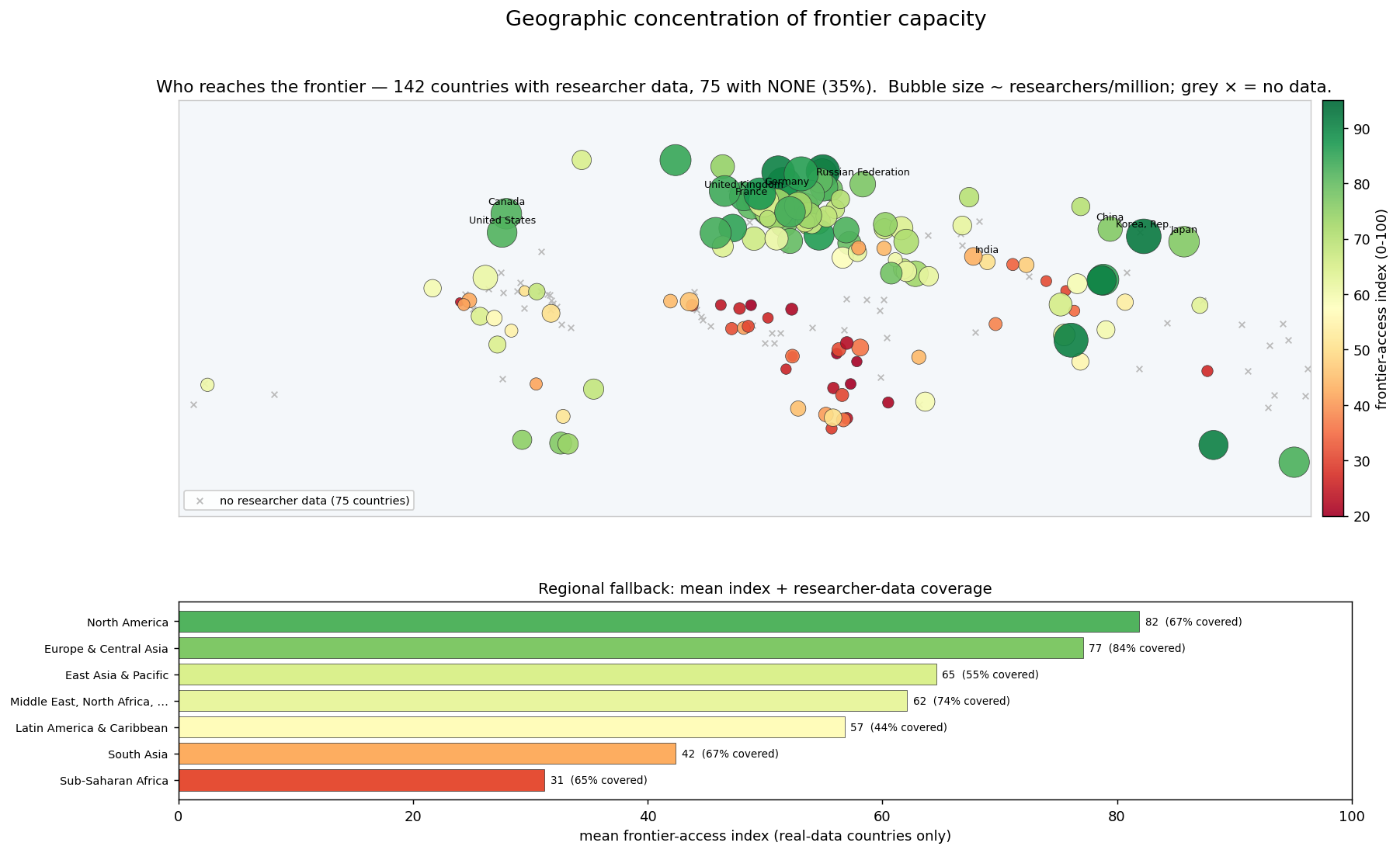
The brutal gradient.
analysis/landscape/figures/fig_geo_choropleth.png
geopandas/Natural Earth was not available at generation time, so the map degrades gracefully (as designed) to a real-geography country-bubble map: Each country plotted at its (longitude, latitude) from country.parquet, sized by researchers/million, colored by the index, plus a regional bar fallback Panel. The script auto-upgrades to a true filled choropleth the moment geopandas is installed; it never fails on the missing dependency.
The picture is stark: a dense band of dark-green high-index countries across Western Europe, North America, and East Asia (Korea/Japan/Singapore), fading To red across Sub-Saharan Africa and South Asia, with 75 grey ×'s, countries that have no researcher datapoint at all.
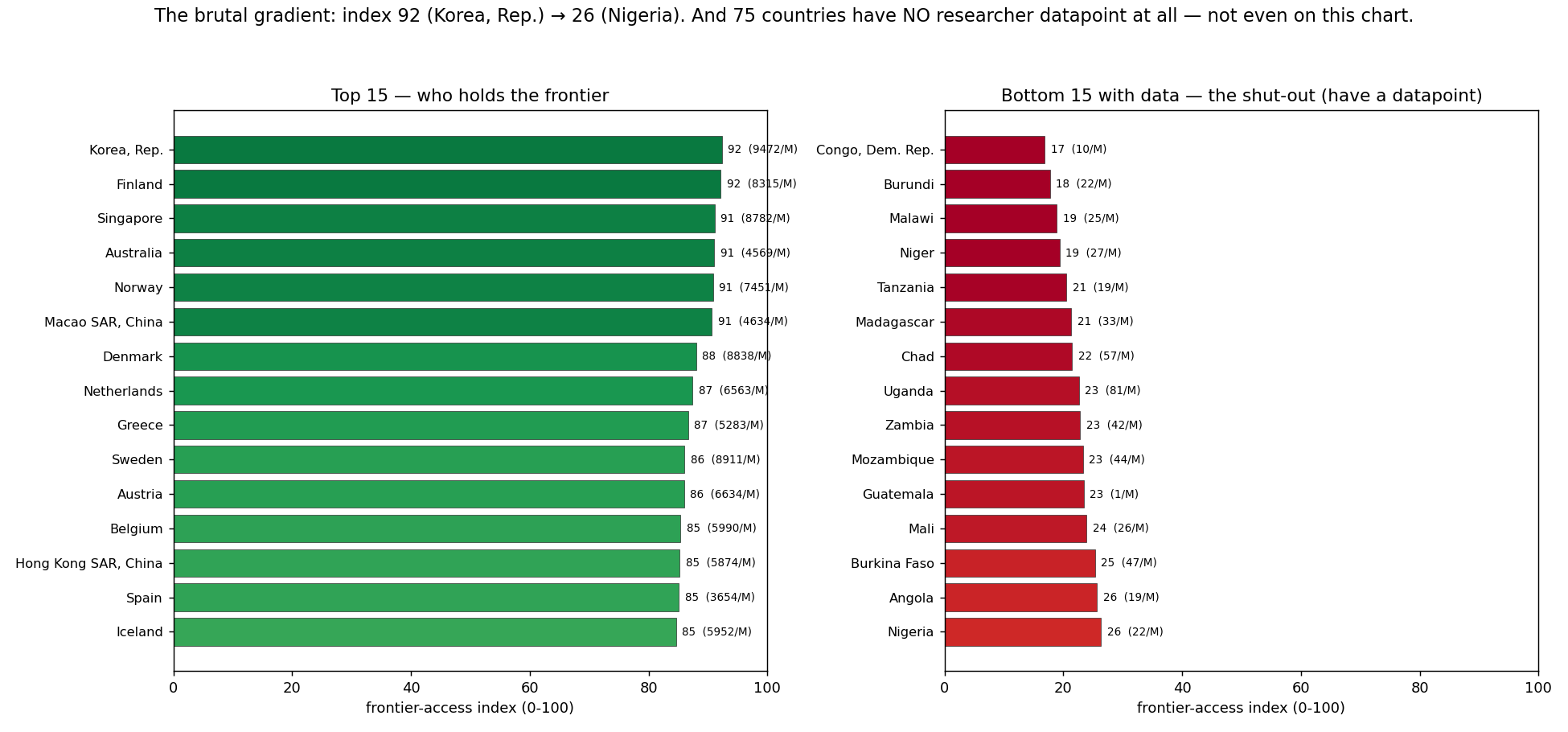
Top 15 vs bottom 15:
analysis/landscape/figures/fig_geo_country_rank.png
| Top of the index | Index | researchers/M |
|---|---|---|
| Korea, Rep. | 92 | 9,472 |
| Finland | 92 | 8,315 |
| Singapore | 91 | 8,782 |
| Australia | 91 | 4,569 |
| Norway | 91 | 7,451 |
| Bottom (countries that do have a datapoint) | Index | researchers/M |
|---|---|---|
| Congo, Dem. Rep. | 17 | 10 |
| Burundi | 18 | 22 |
| Malawi | 19 | 25 |
| Niger | 19 | 27 |
| … Nigeria | 26 | 22 |
The index runs 92 (Korea) → 17 (DR Congo) among countries with data, and the shut-out countries don't appear on the chart at all, because they have no number.
Regional means
| Region | Mean index | Researcher-data coverage |
|---|---|---|
| North America | 81.9 | 67% (2 of 3) |
| Europe & Central Asia | 77.1 | 84% (49 of 58) |
| East Asia & Pacific | 64.6 | 55% (21 of 38) |
| Middle East, N. Africa, Afghanistan & Pakistan | 62.1 | 74% (17 of 23) |
| Latin America & Caribbean | 56.8 | 44% (18 of 41) |
| South Asia | 42.4 | 67% (4 of 6) |
| Sub-Saharan Africa | 31.2 | 65% (31 of 48) |
Sub-Saharan Africa's mean index (31) is less than half Europe's (77), and its researcher intensity averages ~130/M against North America's ~5,280/M.
3. Concentration
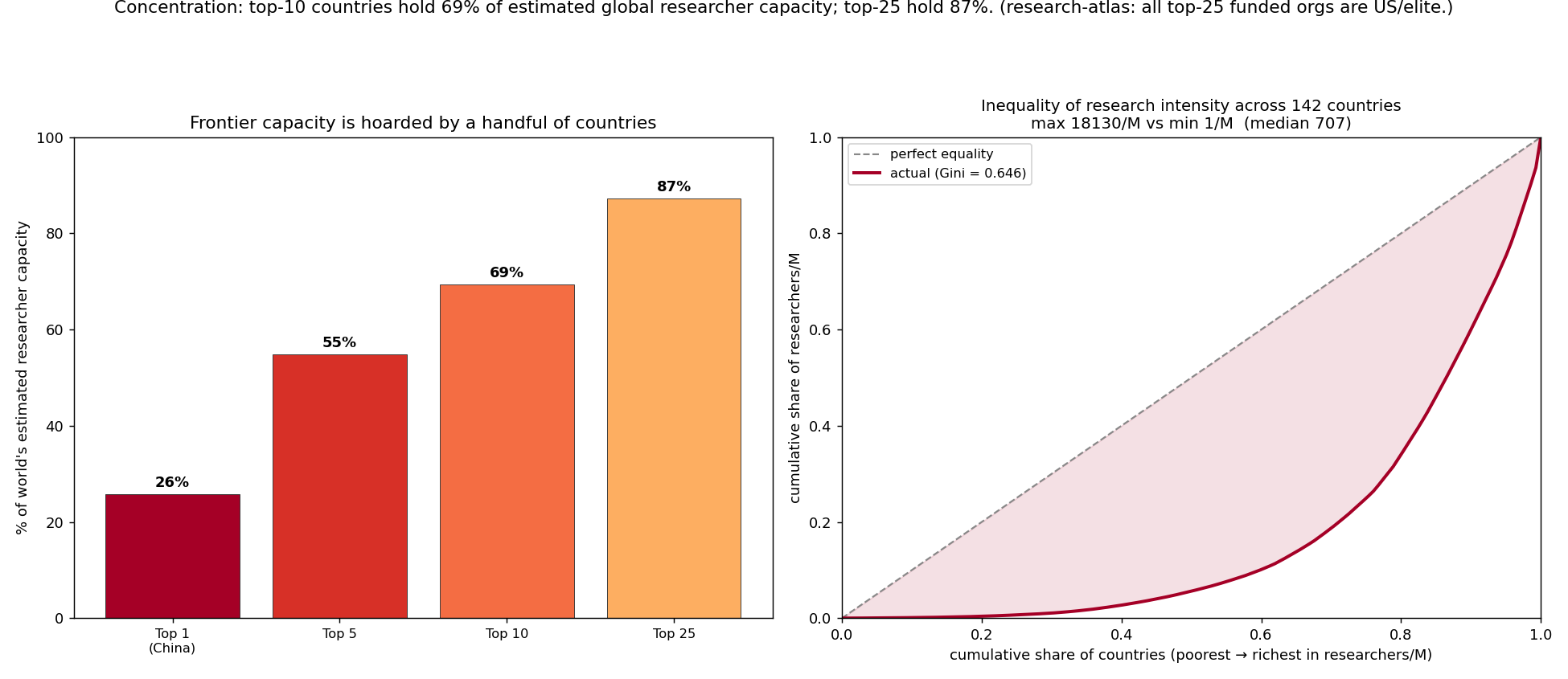
A handful of countries hold almost everything.
analysis/landscape/figures/fig_geo_concentration.png
We estimate each country's absolute frontier capacity as researchers/M × population (SP.POP.SCIE.RD.P6 × SP.POP.TOTL, both real series; the product is an estimated researcher headcount). Across the ~142 countries with the anchor, total estimated capacity ≈ 11.5 million researchers, and it is hoarded:
| Group | Share of world's estimated researcher capacity |
|---|---|
| Top 1 (China) | 25.7% |
| Top 5 (China, US, Japan, Germany, Korea) | 54.9% |
| Top 10 | 69.3% |
| Top 25 | 87.3% |
China + the United States alone hold ~40%. The top-10 countries hold roughly seven-tenths of the world's frontier capacity; the top-25 hold almost nine- Tenths. The long tail of ~117 remaining countries with data splits the last ~13%, and 75 countries split nothing measured.
The Lorenz curve of researchers/M gives a Gini of 0.646 across 142 countries, research intensity is more unequally distributed than income is in most countries. The span is 18,130/M (max) vs 1.4/M (min), ~13,000×; the median country sits at 707/M, barely half the world average of ~1,360/M, because the mean is dragged up by a rich handful.
Cross-check (research-atlas): the org-level finding mirrors the country-level One, all top-25 funded research organizations are US/elite institutions, and the corpus holds ~1.44M distinct researchers. The concentration is fractal: It holds at the country level and again at the institution level.
4. The coverage finding
75 countries are off the map.
The single most result in this layer is what's missing:
Of 217 real (non-aggregate) countries, only 142 have any researcher-per- million datapoint at all. 75 countries, 35% of all countries, have NONE.
These are overwhelmingly low- and lower-middle-income, concentrated in sub-Saharan Africa, small island states, and conflict-affected regions. The absence is not noise, it is the finding. A country with no measured research capacity is not a country with a low-but-known frontier; it is a country whose frontier participation is so thin (or whose statistical capacity is so weak) that the world's flagship R&D indicator has no value for it. Data sparsity is worst exactly where access is worst, so every low-income number in this analysis is an upper bound on a darker reality (the same caveat doc 02 §6 raised).
This is why the bottom-15 chart is labeled "the shut-out who have a datapoint": The shut-out countries can't be ranked, because they don't have a number to rank.
5. The gender cut
analysis/landscape/figures/fig_geo_gender.png
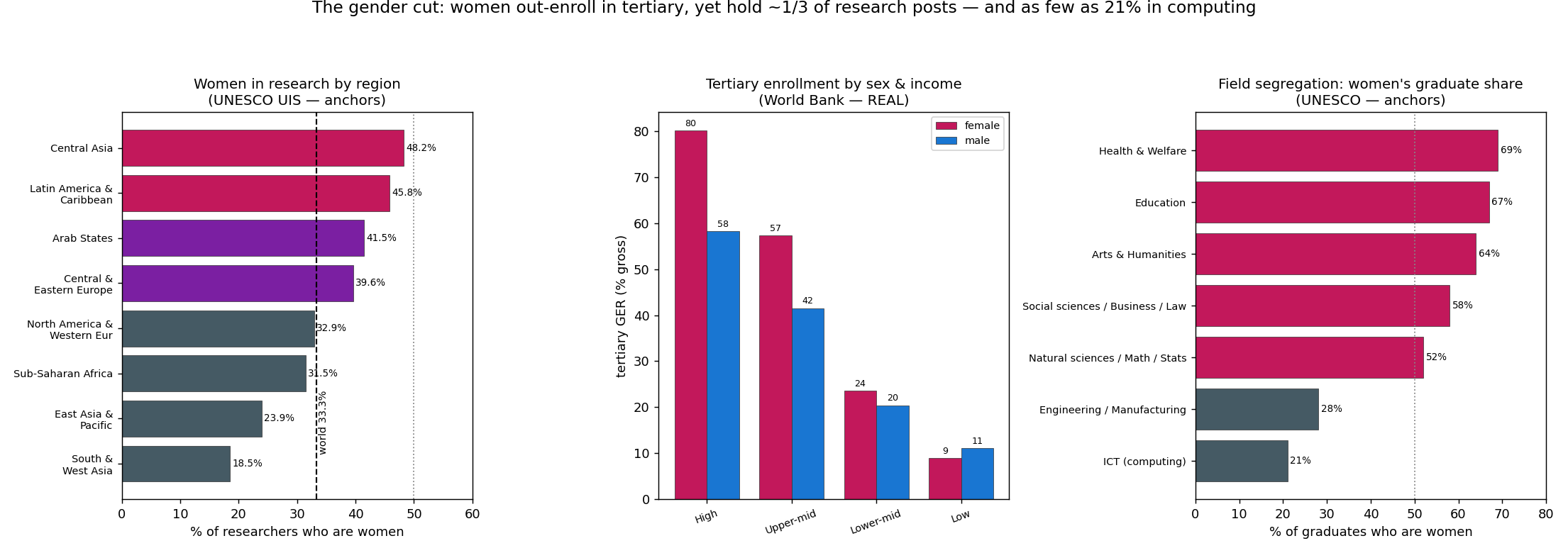
Three panels, two of them real World Bank data, one documented UNESCO anchor:
Women hold ~⅓ of research posts globally, UNESCO
| Region | Women as % of researchers |
|---|---|
| Central Asia | 48.2% |
| Latin America & Caribbean | 45.8% |
| Arab States | 41.5% |
| Central & Eastern Europe | 39.6% |
| World | 33.3% |
| North America & W. Europe | 32.9% |
| Sub-Saharan Africa | 31.5% |
| East Asia & Pacific | 23.9% |
| South & West Asia | 18.5% |
The global figure is ~33%, and the rich research regions (North America/W. Europe, East Asia) sit at or below the world average, while Central Asia and Latin America are near parity. The frontier's gender gap is not a "developing-world" Story; it's worst at 18.5% in South & West Asia but stubbornly stuck around a third in the regions that produce most of the world's research.
The leak is post-degree, World Bank
Real tertiary gross enrollment by sex shows women now out-enroll men: world mean female 52.4% vs male 39.3% (+13.1 points). The female advantage widens with income (+21.9 pts high-income, +15.8 upper-mid, +3.3 lower-mid) and flips negative in low-income countries (−2.2 pts), the one tier where women Still trail men into university at all.
So women enter higher education in equal or greater numbers nearly everywhere, yet hold only a third of research posts. The pipeline doesn't leak at the classroom door, it leaks between the degree and the lab.
Horizontal segregation, UNESCO
Women's share of graduates by field: Health & Welfare 69%, Education 67%, Arts & Humanities 64%, but ICT/computing 21%, Engineering 28%. Even where women reach the frontier, they are routed away from the fields (computing, engineering) That dominate the research corpus measured in doc 03.
6. The rural / wealth cut
Globally-comparable rural-urban and wealth-quintile depth data lives in DHS microdata, which is not in this repo's cache, so these are cited UNESCO GEM/WIDE anchors (flagged estimated):
- In low/lower-middle-income countries, tertiary completion is a
top-wealth-quintile phenomenon: ~9% of the richest quintile completes tertiary vs ~0.5% of the poorest, an ~18× gap, inside a single country.
- Primary completion in low-income countries: ~70% urban vs ~45% rural, a
25-point gap that compounds up every depth rung, so by the frontier the rural poor are absent entirely.
The geographic gradient (§2-4) is therefore the outer shell; inside each shut-out country sits the same gradient again by wealth and location.
7. What's real vs. estimated
| Component | Status | Anchor / assumption |
|---|---|---|
| Researchers/M, per country | REAL | World Bank SP.POP.SCIE.RD.P6, latest per country |
| Tertiary GER / completion / internet, per country | REAL | SE.TER.ENRR, SE.TER.CMPL.ZS, IT.NET.USER.ZS |
| Female/male tertiary GER | REAL | SE.TER.ENRR.FE / .MA, latest per country |
| Population (for absolute capacity) | REAL | SP.POP.TOTL |
| Composite index (0-100) | Real inputs × documented weights | 0.40/0.25/0.15/0.20; researchers/M log-scaled |
| Non-anchor gaps in the index | IMPUTED (flagged) | income-group mean; completion 23, GER 6, internet 1 |
| Absolute frontier capacity | ESTIMATED | researchers/M × population = estimated headcount |
| Top-share / Gini | computed on the estimate | over 142 data-carrying countries |
| Women researchers % by region | DOCUMENTED ANCHOR | UNESCO UIS Women in Science (no clean WB series) |
| Women graduate share by field | DOCUMENTED ANCHOR | UNESCO "Cracking the code" / UIS |
| Rural-urban / wealth-quintile gaps | DOCUMENTED ANCHOR | UNESCO GEM / WIDE (DHS-backed; not in cache) |
| Depth ladder L0, L5 | CONSTRUCTED | scale.py analytical frame |
Known limitations. (1) Absolute capacity uses the latest available year per Country, which differs across countries (most 2018-2023). (2) Researchers/M itself under-measures countries with weak statistical systems, the 75 missing countries are the extreme of this. (3) The composite weights are a defensible choice made on judgment; the ranking holds up under reasonable reweighting, the absolute scores less so. (4) Women-in-research and rural/wealth numbers are cited regional/global anchors, taken at that level of aggregation.
8. Headline
The frontier has a geography, and it is a near-monopoly. Of 217 countries, only 142 have any measured researcher capacity at all, 75 (35%) have none. Among those that do, the composite frontier-access index runs 92 (Korea) to 17 (DR Congo), and Sub-Saharan Africa averages 31 against Europe's 77. Absolute frontier capacity is hoarded: the top-10 countries hold ~69% and the top-25 hold ~87% of the world's ~11.5M estimated researchers, with China + the US alone at ~40%, a Gini of 0.646 and a ~13,000× span from the most to least research-intensive country. The org-level mirror (research-atlas: all top-25 funded orgs US/elite) confirms the concentration is fractal. And the gender cut shows the gap opens after the degree: women now out-enroll men into university worldwide (+13 points), yet hold only ~33% of research posts (as low as 18.5% in South & West Asia and 21% in computing). The frontier is reached by a few countries, and within them, unevenly by gender, wealth, and place.
9. Reproduce
cd analysis/landscape
python3 build_geographic.py            # -> results_geographic.json (fetches+caches 6 WB series)
python3 make_figures_geographic.py     # -> figures/fig_geo_*.png
python3 -m pytest test_geographic.py -q # pins the headline numbers
Files: `analysis/landscape/build_geographic.py` (analysis), make_figures_geographic.py (figures), results_geographic.json (output), test_geographic.py (regression guard). World Bank series cached in data/raw/worldbank/ (same key format as edu/connectors/worldbank.py, so a full atlas refresh reuses them).